
At the A.F. Khristenko Karaganda Agricultural Experimental Station, subordinate to the NJSC 'National Agrarian Scientific and Educational Centre' (NASEC), grain was exported via fictitious transactions, and employee bonuses were paid from budgetary funds in violation of the established procedure. The Ministry of Agriculture (MoA) officially acknowledged these facts in its response to a request from the editorial board of FBK, thereby highlighting a second episode of financial violations within the structures of the same holding company in recent months.
WHAT HAPPENED
Not so long ago, the FBK editorial board reported on the situation at the A.I. Barayev Research and Production Centre for Grain Farming (RPCGF) - an organisation subordinate to NASEC. This concerned a change in management and subsequent potential pressure on the finance department, opaque asset transactions, and personnel appointments that raised questions about connections between appointees and the interests of third-party entities. The Chief Accountant of the Centre, Gulnar Kabdina, reported on this at the time.
Incidentally, very recently, the editorial board received a pre-trial claim from the leadership of the Barayev Centre, Bauyrzhan Kalibayev and Yuri Dolinny, demanding the removal of FBK publications and the publication of a retraction.
The authors of the claim assert that the publications contain 'information that does not correspond to reality, defaming the honour, dignity and business reputation'. Specific complaints include mentions of violations of financial discipline, personnel pressure, fictitious electronic invoices and inflated production costs for hay. According to the claimants, none of these assertions are supported by 'admissible evidence'.
This is a strong argument. Of course, that is if you do not read the material itself. Right at the beginning of the text, it is clear that FBK did not make accusations on its own behalf. Our editorial board used Kabdina's appeal - a document sent to state bodies. This is the very essence of journalism: to publicise information that was addressed to those obliged to respond to it.
FBK is preparing a response to the pre-trial claim within the timeframe established by law. We are also confident that all the information presented in the publications has a proper factual basis and is confirmed by materials available to the editorial board. However, the most convincing response to the demands to remove the publications turned out to be not even our arguments, but subsequent events. Shortly after the publication of articles about the Barayev Centre, our editorial board began to receive reports of similar problems in other organisations within the NASEC system.
One such report concerned the Karaganda Experimental Station. According to information we received, the former management of the enterprise may have exported grain without proper documentation and write-off. There were also reports of possible pressure on employees who objected to such actions, conflicts arising within the team, and possible violations in the awarding of bonuses using budgetary funds.
The FBK editorial board decided to investigate the situation and sent an official request to the Ministry of Agriculture, where we also revisited the Barayev Centre case, asking for clarification on what specific measures had been taken following the previously announced audit.
WHAT THE MINISTRY SAID IN RESPONSE
The Ministry's response confirmed some of the concerns. The Ministry's Internal Audit Department conducted a state audit of the effectiveness of the activities of the A.F. Khristenko Karaganda Agricultural Experimental Station for the period from 1 January 2023 to 31 December 2025. The inspection found that grain was exported using fictitious documents. The accounting records show the shipment of Class 5 wheat and grain waste to individuals totalling 1,144,780 kg, even though these individuals explained during cross-checks that they did not purchase, export, or pay for the product. According to the response, the product was exported on the direct orders of the former Chairman of the Board, and the violations amounted to over 10.1 million tenge.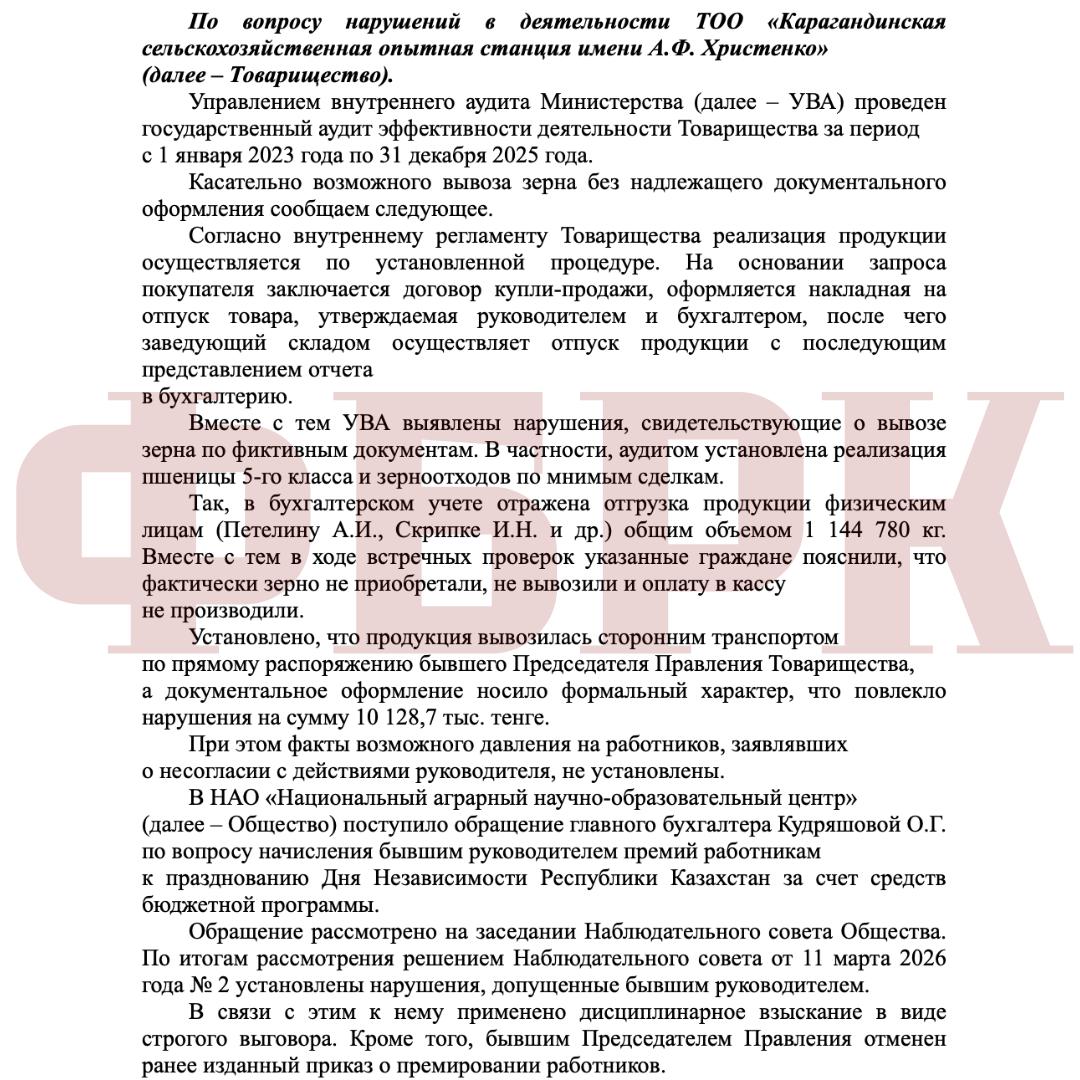
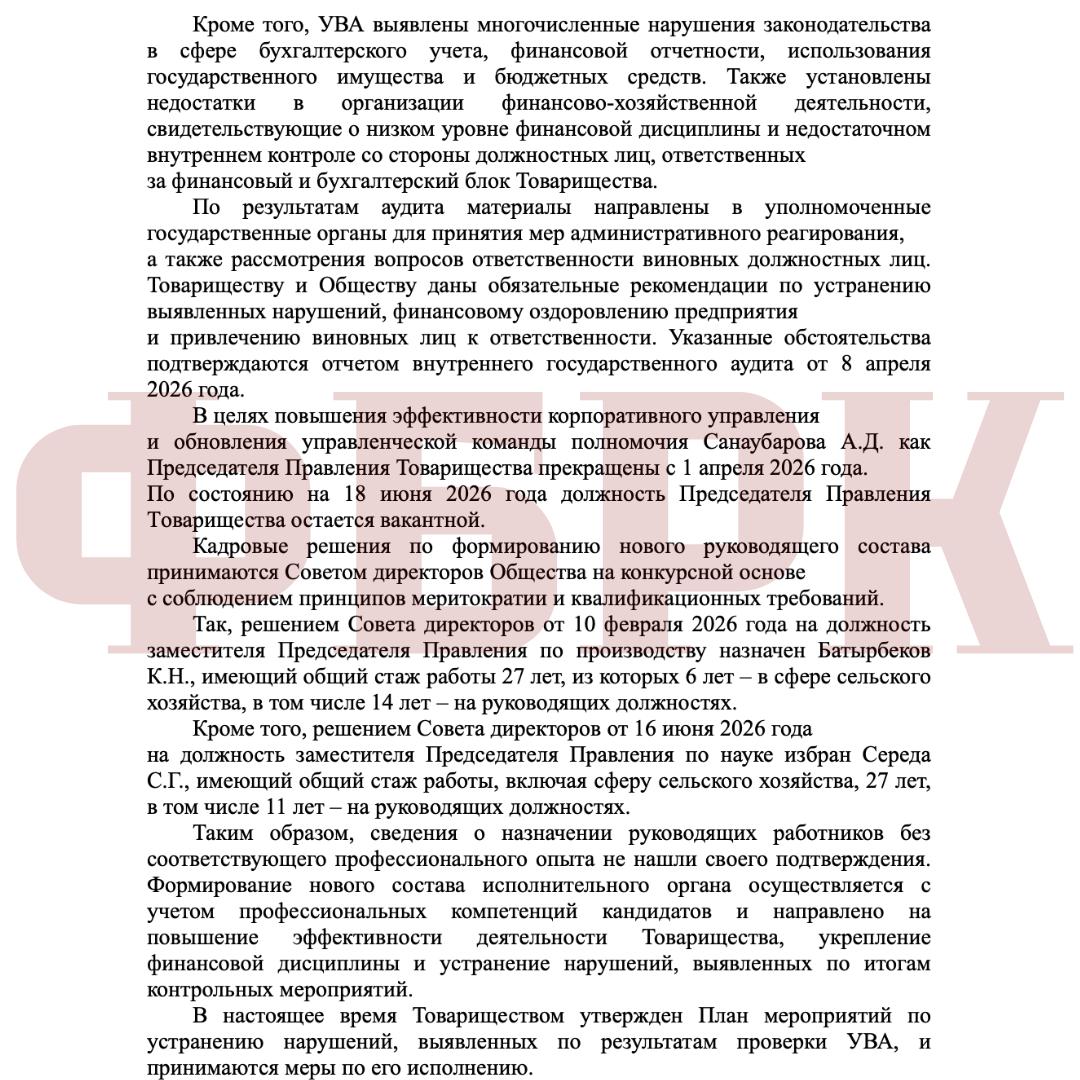
The episode regarding bonuses was also confirmed. NASEC received an appeal from the chief accountant, Kudryashova, regarding the former director awarding bonuses to employees for Independence Day celebrations using a budget programme. As a result, the former director received a disciplinary sanction in the form of a severe reprimand (whatever that means), and the order for the bonuses was revoked by the same person.
However, the Ministry did not confirm the facts of pressure on employees who objected to the director's actions. According to the agency, concerns about new personnel appointments were also not confirmed.
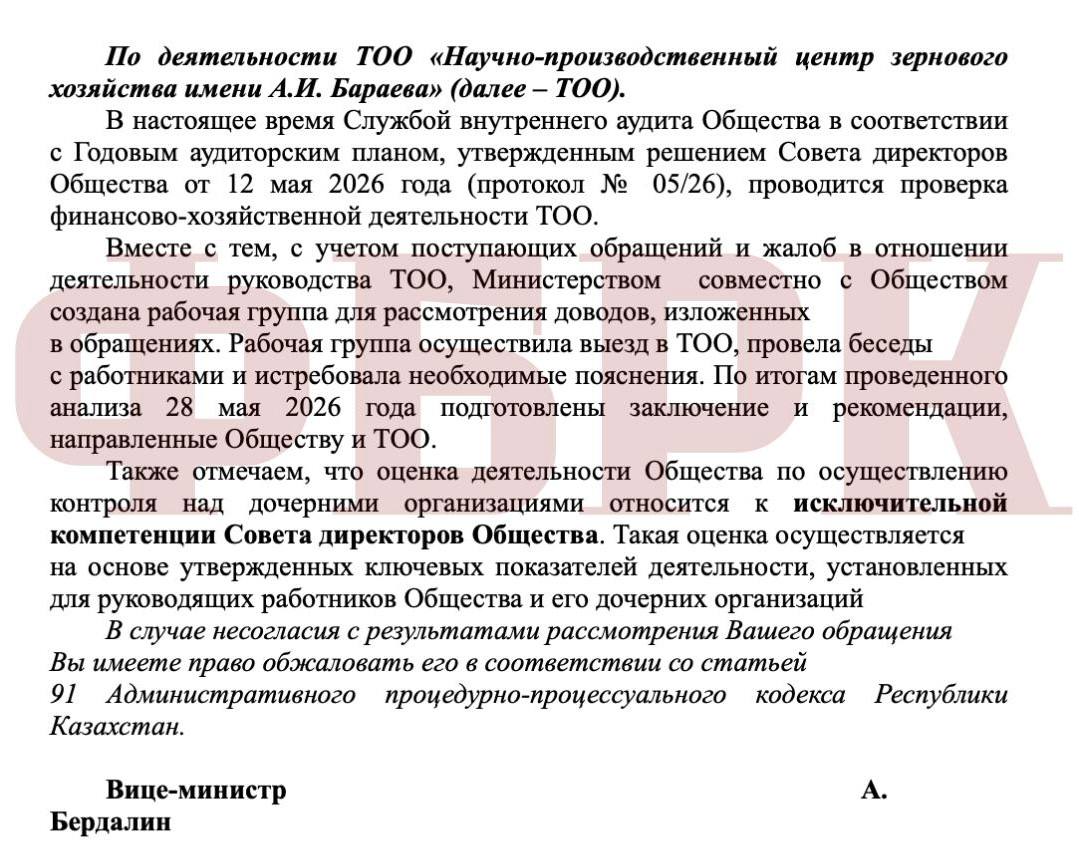
In turn, regarding the case of the Barayev Centre, the Ministry reported that the Internal Audit Service of NASEC is conducting an audit of financial and economic activities as part of the annual audit plan approved by the decision of the NASEC Board of Directors on 12 May 2026. The working group of the Ministry and NASEC that visited the Centre prepared a report and recommendations on 28 May 2026, which were sent to both entities; however, the content of these conclusions was not disclosed in the response (again).
WHAT THIS MEANS
If we consider both episodes not as isolated incidents but as part of one system, a very persistent pattern emerges. In both organisations, violations of financial discipline linked to a change in management have been found; in both, there are questions regarding personnel appointments, although in the Karaganda case, the Ministry considered them justified; in both, there is a lack of transparency regarding the further consequences of the audits. Is this still not enough to raise the question of systemic corruption? Or should we wait for new episodes before having that conversation?
The key point highlighted by this Ministry response concerns precisely the distribution of powers within the holding company. The Ministry directly stated that the assessment of NASEC's own performance in controlling its subsidiary organisations falls within the exclusive competence of the Company's Board of Directors. In other words, an external state body, the relevant ministry, is not authorised to initiate an audit of the effectiveness of the parent structure's control over its 'subsidiaries'. This competence is contained within the holding company itself. That is, NASEC simultaneously acts as both the object of potential claims and the sole entity capable of initiating their investigation.
Under this arrangement, each new instance of violations in subordinate organisations, be it the Barayev Centre, the Karaganda Station, or any subsequent structure, will be dealt with according to the same scheme: internal audit, internal working group, internal recommendations. External control is limited to the Ministry being able to request a report on the results, but it cannot itself initiate an assessment of why such violations are recurring from one organisation to another.
So, how many more such episodes must surface in NASEC's subsidiary organisations before the subject of an investigation becomes not yet another 'subsidiary', but the holding company's management model itself?