A briefing from the Ministry of Agriculture on the conclusion of the fight against locusts unexpectedly brought back the story of last year's legal disputes between the department and the FBRK. The reason was not new accusations, but statements from the ministry's own representatives, who today effectively used the same terminology and referred to the same international organisation that had been at the centre of legal battles just a year ago.
WHAT HAPPENED
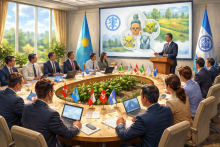
The briefing at the Central Communications Service (CCS) under the President of the Republic of Kazakhstan was dedicated to the results of protective measures against locust pests. Representatives of the Committee of State Inspection in the Agro-Industrial Complex of the Ministry of Agriculture (MoA) reported a reduction in treatment areas, the introduction of digital solutions, and specifically highlighted cooperation with the Food and Agriculture Organisation of the United Nations (FAO).
According to the committee chairman, Saken Kanybekov, the international organisation is involved in developing digital monitoring, providing expert support, and joint projects have been running for several years.
These statements inadvertently recalled the legal proceedings that MoA structures initiated last year against the founder of the FBRK, Kirill Pavlov. At that time, a department representative, lawyer Venera Tapayeva, objecting to the use of FAO data, stated in court that it was an 'incomprehensible organisation' without a licence.
On 5 June 2025, a journalist was fined an amount of 78,640 tenge (20 MCI) under Article 456-2, part 3 of the Administrative Code of the Republic of Kazakhstan for a publication about the scale of the locust invasion in Kazakhstan.
This is precisely why one of the first questions from Kirill Pavlov concerned the department's clearly changed position. The journalist asked whether the current active cooperation means that the FAO has suddenly become a 'more understandable organisation' for the ministry, or whether it was finally granted a licence. In response, Saken Kanybekov stated that the MoA works 'very closely' with the FAO, jointly implements projects and receives support from the organisation in implementing digital solutions.
Judging by the response, the irony of the question itself went unnoticed.
CAN 'DISTRIBUTION RANGE' NOW BE USED?
Interestingly, even before Pavlov's question, while answering another journalist, Saken Kanybekov himself used the phrase 'distribution range' when describing the situation with locust pests in the country's regions.
The use of this very phrase was previously the subject of a dispute between the MoA and the founder of the FBRK. The argument was precisely about the difference between the locust distribution range, the area of infestation, and the treatment area. According to Pavlov, he was writing specifically about the distribution range – the territory where locusts could appear – but the ministry disagreed with this interpretation.
Now, the same term has been used as part of an official comment from the relevant department itself. Just a year ago, using this phrase was grounds for legal claims, and today it is used by the department's own representatives as a standard professional term. Apparently, the permissibility of using this term depends less on its meaning and more on who exactly is uttering it.
HOW THE FITOCENTRE SYSTEM WORKS
Pavlov's second question concerned the geographic information system FITOCENTRE, designed for digital support of phytosanitary monitoring. The journalist asked what acceptable error margin is provided for the system and what the maximum level of false alarms is. The committee representative first talked about the pilot implementation and system refinement, and after clarification, reported that the discrepancy rate had been reduced from approximately 15% to 5%.
During this same response, the MoA representative unexpectedly stated that the department 'works very closely' with the journalist, responding to his publications and comments. Kirill Pavlov noted, however, that he was hearing about such cooperation for the first time. However, he clearly remembers last year's court proceedings, as well as being forcibly taken to the Kostanay police department to participate in one of the court hearings.