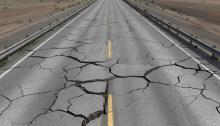
Abnormally high air temperatures in Kazakhstan have led to thermal deformation in certain sections of concrete roads. Such changes are a predictable operational factor during extreme heat and do not indicate poor-quality road construction.
WHY DEFORMATION OCCURS
According to the Republican State Enterprise 'National Centre for Road Asset Quality' of the Ministry of Transport, in recent weeks the air temperature in several regions of the country has reached +35...+40 °C, and in some places has exceeded +40 °C. At the same time, the road surface can heat up to +60...+70 °C or more.
Under these conditions, concrete slabs expand due to the high temperature. If the resulting internal stresses cannot be fully compensated for by expansion joints, buckling or localised lifting of the slabs may occur in certain areas.
WHAT THE EXPERTS SAY
The department noted that such thermal deformation is considered a recognised operational risk for concrete roads and has long been known in international engineering practice. Similar cases have been recorded numerous times in the USA, Canada, UK, Germany, South Korea, Australia, and other countries with extensive networks of concrete roads, according to the report.
The report also emphasises that the occurrence of such deformation does not in itself indicate violations in road design or construction, as concrete pavements are subject to the effects of extreme temperatures in accordance with the laws of physics.
WHAT MEASURES ARE BEING TAKEN
According to information from the National Centre for Road Asset Quality, road organisations in Kazakhstan are currently conducting round-the-clock monitoring of the condition of concrete roads. All identified defects are being rectified promptly using technologies specified in regulatory and technical documents.
The report also notes that in international practice, during periods of abnormal heat, road services increase monitoring of such sections, carry out work to relieve internal stresses in the slabs, lay temporary or permanent asphalt concrete surfaces where necessary, regulate traffic, and inspect the most heavily loaded road sections.
WHAT THIS SITUATION MEANS
The temperature of the road surface can significantly exceed the air temperature. When the air temperature is +40 °C, the surface of a concrete road can heat up to +65...+75 °C, creating extreme operating conditions.
The department reported that the situation is under constant supervision by the Ministry of Transport, and monitoring continues on an intensified basis.
CONTEXT
The FBRK has previously drawn attention to the problem of recurring deformation of concrete roads in Kazakhstan. In one of its episodes on YouTube, the editorial team analysed cases that occurred in different years on the Astana – Pavlodar, Taraz – Kainar, and Shymkent – Taraz highways.
As noted in the review, almost every such incident was accompanied by a similar official explanation from JSC 'NC 'KazAvtoZhol': the cause was stated to be thermal expansion of concrete slabs during intense heat. In its comments, the national operator also cited international experience, noting that similar deformation had been recorded in the USA, Germany, Poland, and other countries.
Meanwhile, such cases in Kazakhstan have been occurring regularly during the summer period for several years. For instance, on 1 June 2026, buckling of the surface was reported on the KAZ04 'Astana – Pavlodar' highway, where the cause was again a rise in air temperature to +35...+37 °C. Preventive work was carried out on the section at the time, but it was not possible to prevent the surface deformation.
The editorial team also noted that in countries with extensive networks of concrete roads, great attention is paid to preventive maintenance of the surface, including the condition of expansion joints, as these are what compensate for slab expansion during high temperatures.