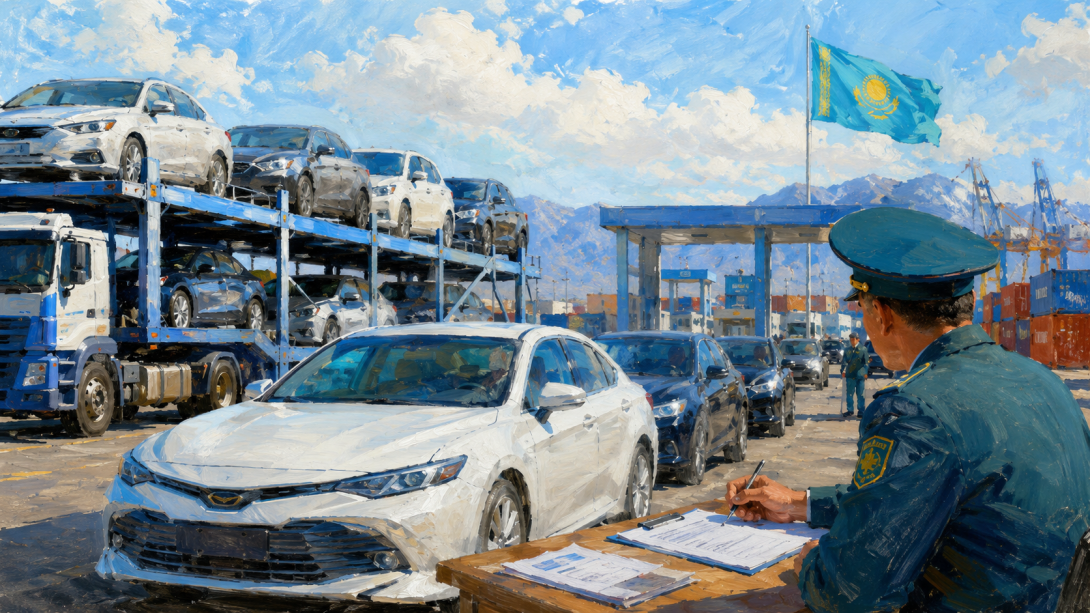
Deputy Minister of Industry and Construction of Kazakhstan, Olzhas Saparbekov, explained why the state has tightened control over grey imports of cars. According to him, after the digitalisation of customs systems, cases were identified where individuals imported dozens, and even hundreds, of cars under the guise of vehicles for personal use.
WHY CONTROL HAS BEEN TIGHTENED
As reported by El.kz, Olzhas Saparbekov explained that the rule allowing an individual to import only one vehicle per year was in effect in Kazakhstan from 2015 to 2017. For a long time, its enforcement was monitored only formally.
According to the Deputy Minister, the situation changed with the digitalisation of the customs system. From 2025, an electronic vehicle passport became mandatory, which consolidates information on conformity assessment, environmental requirements, and customs regulation. After the integration of previously separate databases, cases requiring verification were identified.
WHAT SCHEMES WERE IDENTIFIED
According to Olzhas Saparbekov, last year approximately 100,000 cars were imported into Kazakhstan. Less than 5% of these were registered as vehicles for personal use, while the rest were processed as goods for commercial trade.
The Deputy Minister stated that under one identified scheme, a car was first registered with a safety certificate for personal use, and then, during customs declaration, it was processed as a commercial commodity. After the integration of state information systems, such discrepancies became visible.
Also, according to Saparbekov, cases were identified where individuals imported more than 10, more than 100, and even over 700 cars per year. In his opinion, such volumes are comparable to commercial activity.
WHAT RISKS WERE IDENTIFIED FOR BUYERS
The Deputy Minister divided market participants into official dealers and manufacturers operating under brand licences, and so-called grey dealerships, which, he stated, have no similar obligations regarding warranty service and after-sales support.
According to Olzhas Saparbekov, when purchasing a car through such channels, consumers may face issues concerning compliance with safety requirements, warranty service, the vehicle's participation in possible manufacturer recall campaigns, and conformity with technical regulations, especially when it comes to used vehicles.
WHAT WAS REPORTED ON BUDGETARY LOSSES AND AUTOMOTIVE INDUSTRY DEVELOPMENT
According to the Deputy Minister, the state may be losing customs duties and taxes, but specific amounts were not provided in the interview. He emphasised that the ministry is focused on ensuring compliance with existing regulations, rather than tightening them.
Separately, Olzhas Saparbekov spoke about the development of Kazakhstan's automotive industry. According to him, car production grew from approximately 3,000 vehicles in 2010 to over 170,000 last year, and this year the sector is approaching the 200,000-vehicle mark. He also stated that the level of production localisation, according to various assessment methods, has reached 50%.
The Deputy Minister also reported that the Chinese company Li Auto has decided to open production in Kazakhstan, and he cited the Kia plant in Kostanay as an example of existing localisation.
CONTEXT
The issue of illegal import and registration of cars in Kazakhstan has been raised before. The editorial team of FBRK (Anti-Corruption Fund) has repeatedly highlighted the existence of schemes related to grey vehicle imports and their subsequent legalisation for several years.
After the European Union imposed restrictions on Russian road transport operators in 2022, some transport companies began relocating their activities to Kazakhstan. In an FBRK investigation, the practice of establishing joint ventures, the registration of freight transport, issues concerning the use of state registration plates, the shortage of foreign permit forms (FPF), as well as repeated changes to international transport rules involving trailer swapping and transhipment were examined in detail.
In 2023, a campaign to legalise cars imported before 1 September 2022 was completed in Kazakhstan. The editorial team thoroughly analysed the registration procedure, the specifics of temporary vehicle registration for cars not deregistered in EAEU countries, and the associated risks of illegal registration and fraudulent schemes. That same year, at a meeting in Kostanay, FBRK founder Kirill Pavlov stated that there were approximately 700 cars with altered VIN numbers in the city alone, and a further 400–500 in Petropavlovsk. He then proposed transferring such vehicles to rural teachers, doctors, and district police officers after legalising their status.
In July 2024, Kirill Pavlov published a personal investigation into Kazakhstan's grey car market, in which he detailed the schemes for illegally registering vehicles imported across the Kazakh border.
In January 2025, the Supreme Audit Chamber (SAC) reported that potential budget losses from shadow car imports could exceed 71 billion tenge. This assessment became one of the most significant official indications of the economic consequences of grey car imports in the country.