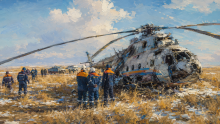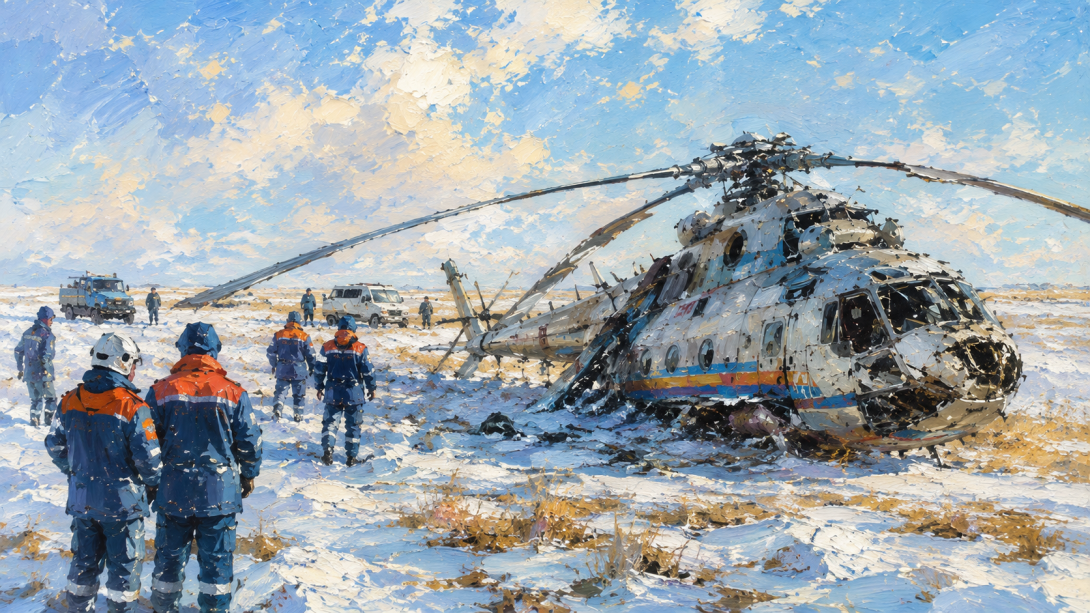
In court hearings on the Mi-8 disaster in the West Kazakhstan Region (WKR), witness Nurbek Shakishev cited the causes that the aviation commission listed in its investigation materials. According to him, the crew lost visual contact with the ground, failed to make a timely decision to turn back, and did not manage to climb to a safe altitude.
WHAT THE AVIATION COMMISSION ESTABLISHED
As reported by the publication "My City", on 18 August, at a hearing of District Court No. 2 of the Baiterek district, Nurbek Shakishev was questioned. At the time of the disaster, he was working as chief expert at the aviation accident and incident investigation department of the Ministry of Transport and was a member of the investigation commission.
The witness listed four factors cited in the report: inadvertent entry into weather conditions below minimums with loss of visual contact with ground objects, failure to make a timely decision, failure to climb to a safe altitude, and failure to use ground proximity warning systems.
Shakishev stressed that an aviation investigation does not establish blame. According to him, the commission determines the causes and contributing factors of an incident and develops recommendations to prevent similar disasters.
WHY THE CREW CONTINUED THE FLIGHT
According to the witness, on 23 February 2023 the crew received meteorological information before departure. The flight, requested by KazTransOil JSC, was initially scheduled for 22 February, but was postponed due to weather conditions.
During the flight, weather conditions deteriorated. The crew lost visual contact with ground objects and navigated by reference to power poles. Meanwhile, the aircraft commander, Davletbay Kanatov, was not qualified for instrument flying. When the poles were no longer visible, the crew decided to turn back, but there was no longer enough time to climb to a safe altitude.
In the investigation materials, the crew's actions were described as an error rather than a violation. Shakishev noted that the commander did ultimately decide to turn back, but did so too late.
WHAT THE CREW'S CONVERSATIONS REVEALED
The court also heard excerpts of the crew's conversations from the 12 minutes before the disaster. The pilots repeatedly mentioned deteriorating weather, strong crosswinds and poor visibility.
During the discussion, the commander asked the flight engineer whether it was necessary to continue the flight to the designated point. A representative of the client also took part in the conversation and later suggested returning to the airport. Shortly before the disaster, the commander made the decision to turn back and then reported the need to gain altitude.
Shakishev stated that the circumstances of the conversations require further investigation, in particular the question of why the commander consulted with the client's representative. At the same time, the witness stressed that, under the rules, the decision to continue or abort a flight rests with the aircraft commander.
WHY THE RESCUE OF THE CREW TOOK TIME
The court also separately discussed the operation of the emergency locator beacon and the search for casualties. According to Shakishev, after the crash the commander was still alive and, through one of the crew members, relayed preliminary location data. However, according to him, the coordinates were passed to rescuers with a delay.
The witness also said that the emergency locator beacon did not activate. According to the investigation materials, the cause may have been the nature of the impact: the helicopter did not sustain a heavy impact but merely touched the ground. In its recommendations, the commission proposed modifying the system so that the beacon would activate automatically after engine start-up.
According to Shakishev, the loss of time mattered for saving the casualties. At the scene, there were also difficulties with using the coordinates and with access for heavy equipment, which required a tractor.
CONTEXT
The disaster occurred on 23 February 2023, six kilometres from the village of Beibitshilik. The helicopter was on a commercial flight requested by KazTransOil JSC. Four crew members died in the crash, and two other people were injured.
Charges under Part 3 of Article 344 of the Criminal Code of the Republic of Kazakhstan ("Violation of traffic safety rules or operation of air transport, resulting through negligence in the death of two or more persons") were brought against the deceased commander Davletbay Kanatov and the co-pilot Vladimir Afanasyev.
The Ministry for Emergency Situations (MES) of Kazakhstan filed a court claim seeking to recover compensation from the insurance company "Eurasia" for the crashed Mi-8 helicopter. The claim amounts to approximately 8 billion tenge and has become a point of dispute between the parties.