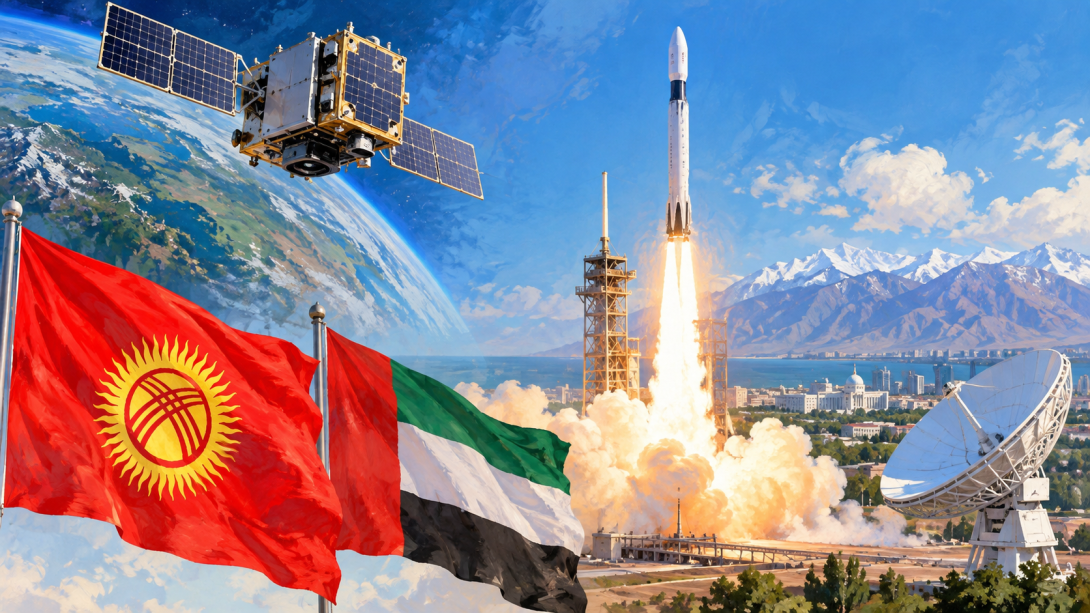
In Kyrgyzstan, questions have arisen about the origin of the satellite whose launch the authorities presented as an achievement of the domestic space industry. After the launch on 1 October 2026, reports emerged of a joint project with the United Arab Emirates (UAE) and the possible existence of two different spacecraft. There is still no final clarification of which satellites were put into orbit and who controls them.
WHAT IS KNOWN ABOUT THE LAUNCH
According to The Diplomat, Kyrgyzstan announced the launch of a nanosatellite using a SpaceX rocket from the US Space Force base at Vandenberg in California.
Initially, the authorities stated that the 5 kg device, costing around 10–12 million som (51-61 million tenge), had been developed and assembled by the local companies Kyrgyz Asman and Kyrgyz Electronics. The director of the latter company admitted that the satellite's technology was predominantly Russian, but that 10 local engineers had worked on its production.
According to a statement by the Ministry of Water Resources, Agriculture and Processing Industry of Kyrgyzstan, the satellite was supposed to collect data on the condition of crops, identify early signs of drought and monitor the state of glaciers. The stated service life of the device was 15 years.
WHY DOUBTS AROSE
On 2 October, media reports appeared about the UAE's participation in the space project. 3 days later, a Kyrgyz publication reported the creation of a space monitoring centre to receive and process data from the Altair satellite.
Data from the satellite under UAE control was to be provided by the Abu Dhabi Maritime Academy centre. At the same time, Altair was not mentioned in the initial statements by the Kyrgyz authorities, and media in the Persian Gulf states called it the first satellite created by UAE engineers, without mentioning Kyrgyzstan's participation.
COULD TWO SATELLITES HAVE BEEN LAUNCHED
Kaktus Media suggested that two devices could have been put into orbit on 1 October.
Another version was put forward by Dima Balakyrev, who claimed involvement in the development of the project. The photograph he published showed a satellite with the inscription «Made in UAE».
According to Balakyrev, the Earth remote sensing device was a joint project of Kyrgyzstan and the UAE, fully financed through grants and funds from the Abu Dhabi government. He claimed that this satellite was different from the nanosatellite that the Kyrgyz Electronics team had assembled.
At the same time, Balakyrev's exact position and his official role in the project are unknown.
WHAT VERSIONS ARE BEING CONSIDERED
According to one version, Kyrgyzstan did indeed launch a 5 kg nanosatellite, while a larger Altair was put into orbit at the same time. In that case, the country gained access to data from the Emirati device and was simultaneously developing its own project
According to another version, expressed by political scientist Aidarbek Raev, the Kyrgyz nanosatellite might not have been launched at all. This would call into question the initial statements about an achievement of the domestic space industry.
At the time of publication, there is no final confirmation of either version.
WHAT THE PRESIDENT OF KYRGYZSTAN STATED
Sadyr Japarov said on 1 October that having its own satellite would allow Kyrgyzstan to obtain data on agricultural land and weather independently, without paying other states to obtain it. The president also announced the country's intention to develop a space programme.
According to him, provided stability and peace in the region are maintained over the next 5–10 years, Kyrgyzstan could begin launching a telecommunications satellite.
CONTEXT
Similar questions about the independence of the national space programme have also been discussed in Kazakhstan. In February 2024, the national company «Қазақстан Ғарыш Сапары» confirmed the use of foreign satellites. At the same time, in 2023 representatives of the company reported the existence of 4 domestic satellites that help detect forest and field fires using Earth remote sensing.
The Kazakh experience shows that having one's own satellites does not rule out the use of foreign data and technologies.