North Kazakhstan company ‘SK Protein’ is implementing a technology for processing hides into feed protein - a project that appeared promising enough to receive a state grant and attract a private investor. Two years on, instead of completed production, there is a court case, a terminated investment agreement, an attempted bankruptcy, and frozen bank accounts.
The editorial board of FBRK has examined court rulings on the dispute with the investor and on the attempt to have the company declared bankrupt, to show how this story looks in the language of documents.
TWO SOURCES OF MONEY - GRANT AND INVESTOR
The project essentially had two financial pillars. The first was state support: according to open sources, SK Protein LLP is processing hides with the participation of Manash Kozybayev North Kazakhstan State University and in 2024 received a grant of 350 million tenge from the ‘Science Fund’.
The second was private money: even earlier, on 8 June 2023, the company signed a separate agreement with a private investor, individual entrepreneur Zhaslan Biketovich Satubaldinov, for 150 million tenge. It was this second, investor part of the story that ended up in court.
WHAT THE COMPANY SPENT THE INVESTOR'S MONEY ON
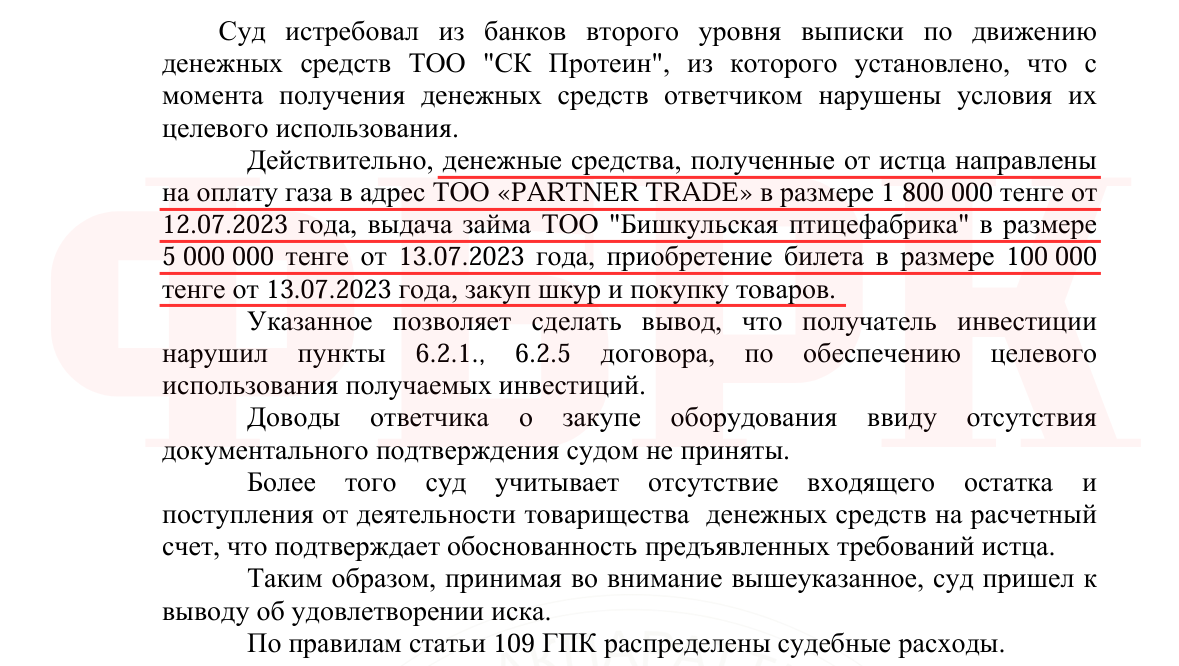
The investor transferred 146.2 million tenge to SK Protein out of the promised 150 million - the money was intended for the purchase of equipment. However, as established by the Specialised Inter-District Economic Court of Astana, part of the funds was directed by the company towards paying for gas, airline tickets, purchasing hides, and issuing a loan to another enterprise - Bishkul Poultry Farm LLP - of 5 million tenge.
THE INVESTOR WENT FURTHER AND RAN INTO THE COMPANY'S BALANCE SHEET
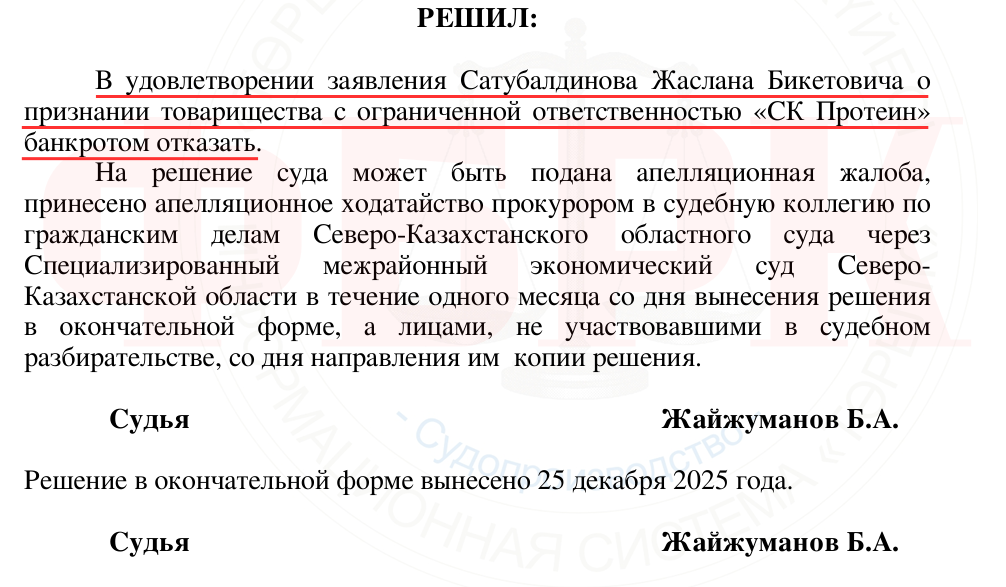
Having failed to secure a full refund, the same investor on 23 October 2025 demanded that SK Protein be declared bankrupt. The logic was simple: if a company cannot pay its debts, it is insolvent. The court disagreed. According to the debtor, the total amount of all its liabilities amounts to 252.7 million tenge, while its assets are valued at 316.8 million tenge - with assets exceeding debts, the court considered the bankruptcy application premature and rejected it.
It is in the materials of this second case that another detail emerges. A bailiff seized the company's production equipment with a book value of 120 million tenge and handed it over for storage to Nurlan Biketovich Satubaldinov.
The surname and patronymic of the investor-applicant and the person to whom the equipment was entrusted for safekeeping coincide. The documents do not allow establishing the nature of their relationship; however, the case materials also show that Nurlan Satubaldinov had already acquired a 50% stake in SK Protein LLP under a contract back in May 2023, although the state re-registration of this transaction has not been completed.
In other words, while one Satubaldinov is suing the company as a defrauded investor, the other was supposed to have officially become its co-owner over two years ago. This transaction simply has never been finalised.
WHAT IS HAPPENING WITH THE COMPANY NOW
The court dispute with the investor and the refusal of bankruptcy have not lifted the financial pressure on the company. According to data from the Kompra.kz service as of 14 July 2026, SK Protein LLP has had its bank accounts frozen, a ban on registration and notarial actions is in effect, a travel ban has been imposed on the director, and the total amount of enforcement proceedings against the company stands at 174.2 million tenge - exceeding even the officially court-recognised debt to the investor. A separate tax debt of 17.9 million tenge is recorded.
According to sources familiar with the situation, the investor additionally provided the company with around 37 million tenge in cash for the purchase of raw materials, and negotiations were also underway with a potential buyer of the protein in China. It should be noted that this information is not confirmed by documents available to the editorial board and is presented as the source's position, requiring separate verification.
HOW THIS CHANGES THE UNDERSTANDING OF THE STORY
The main contradiction in the case is the discrepancy between what the company's balance sheet shows and what the actual enforcement proceedings reveal. The court refused bankruptcy based on the ratio of declared assets to debts, but the methodology for valuing those assets - specifically, the cost of the production line - was not separately examined or challenged in the ruling itself. Meanwhile, the actual picture of the company's finances looks worse than the balance sheet depicts: frozen accounts, a travel ban on the director, and enforcement proceedings amounting to more than the officially recognised debt to the investor.
The transfer of seized equipment for storage to a person who had attempted to become the company's co-owner before the court case adds another layer to the story: it is unclear where the line between conflict of interest and coincidence lies. The court ruling itself does not clarify this issue.
WHAT HAPPENS NEXT
The refusal of bankruptcy does not deprive creditors of the right to re-submit their claims if the debt is not repaid, and with the current volume of enforcement proceedings, such a scenario does not rule out the possibility of creditors re-applying.
The documents do not indicate any violations in the use of the state grant. However, the company's financial problems, confirmed by court rulings and enforcement proceedings, raise the question of how subsequent monitoring is conducted for projects that have received state support.
EDITORIAL OPINION
The SK Protein case is not about proven fraud in court, but about a systemic issue: the extent to which the granting of significant state support is accompanied by subsequent monitoring of the recipient's solvency and good faith. The formal balance sheet indicators, which the court relied on when refusing bankruptcy, are poorly aligned with the actual situation of seizures and debts.
FBRK has previously examined a similar case - the story of the hide processing plant and veterinary facilities in the Akkol district of Akmola Region, where the state authorities' own inspections confirmed operation and construction without the necessary permits.
‘SK Protein’ is a story from a different region with a different set of participants, but it demonstrates the same gap: state support is issued before it becomes clear whether the project is capable of justifying it, whether concerning ecology or controlling the use of grants and protecting investor rights.