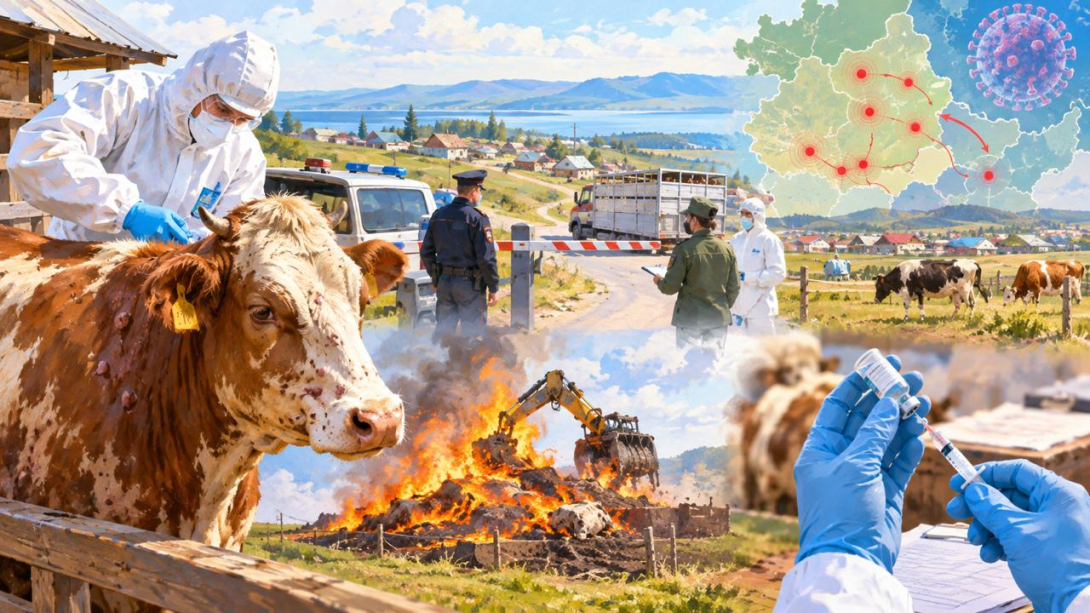
An outbreak of lumpy skin disease in cattle, which has been mowing down livestock in Russia's Irkutsk Okrug since the beginning of September, has spread to a neighbouring district. The state of emergency (SoE) regime now applies in seven settlements in the region, and the seizure and burning of livestock appears to be continuing - despite protests from residents and promised compensation.
HOW THE OUTBREAK REACHED ZAKHAL
Initially, lumpy skin disease was recorded in villages of the Irkutsk Okrug - the villages of Koty, Butyrki, Turskaya, Pozdnyakova, Shiryaevo and the village of Khomutovo. Now the SoE regime has also been introduced in the village of Zakhal in the Ekhirit-Bulagatsky district. According to Governor Igor Kobzev, two hotspots of the disease have been detected there.
WHO IS ON DUTY AT THE BORDERS OF THE HOTSPOTS
Veterinary and sanitary posts are operating at the borders of all seven settlements where the SoE regime applies. Employees of the Ministry of Internal Affairs (MVD) for the Irkutsk region, specialists from the regional veterinary service and representatives of the Rosselkhoznadzor administration for the Irkutsk region and the Republic of Buryatia are on duty.
HOW MUCH LIVESTOCK HAS ALREADY BEEN VACCINATED
Alongside the seizure of infected animals, vaccination of healthy livestock continues in the region. As of 21 September, 113,900 head of cattle and 30,500 head of small ruminants had been vaccinated.
WHAT AFFECTED OWNERS RECEIVED
The regional authorities decided from the outset to seize and burn livestock in the disease hotspots. This practice caused outrage among residents: they were not provided with the animals' test results, and the initial amount of compensation did not satisfy the owners, after which the payment sum was increased. As of 22 September, more than 36 million roubles (around 191.3 million tenge) had been transferred from the reserve fund of the Irkutsk region to 55 animal owners.
ALARM SURROUNDING VACCINATION
Besides the seizure of livestock, the vaccination campaign itself is raising questions among residents. Veterinarians are not showing farmers the documents for the preparation being administered, and in the paperwork the procedure is recorded as "immunisation".
According to the Telegram channel "People of Baikal", the number of lumpy skin disease hotspots by 16 September had risen to 50, and the threatened zone around Khomutovo came to include a further 14 settlements - among them Maksimovskchina, Galki, Revyakina and Sosnovy Bor. According to unconfirmed information, the disease has also spread to the village of Urik, and the number of destroyed animals has exceeded 800 head.
EMKAR IN ZABAIKALYE AND CONCERN IN BURYATIA
Alarm over livestock is also being recorded outside the Irkutsk region. In Zabaikalsky Krai - in the villages of Shishkino in the Chita district and Nizhny Stan in the Tungokochensky district, which are separated by about 250 km - quarantine has been introduced for blackleg (emkar). Unlike lumpy skin disease, only cattle contract blackleg, it is not dangerous to humans, and infected animals are isolated and vaccinated rather than seized and burned. In neighbouring Buryatia, a heightened alert regime is in force against the backdrop of the Irkutsk outbreak.
Recall that FBRK previously examined in detail the theory linked to the spread of foot-and-mouth disease, which independent experts suspect is currently present in Russia. The foot-and-mouth outbreak may be linked not to the natural spread of the disease, but to a laboratory leak. This concerns the foot-and-mouth serotype SAT1 - historically it was characteristic of Southern Africa, but since 2025 it has been rapidly expanding its geography.
Within the serotype, a rare topotype SAT1/III stands out, recorded in Iran and Turkey back in November 2025, and subsequently reaching Cyprus, Greece, two provinces of China and Mongolia's Bayan-Ulgii.
There are grounds to believe that this strain remained "preserved" for a long time under production or laboratory conditions and escaped from there either because of an error during vaccine inactivation or because of a direct leak from production.
Azerbaijan's recent notification of a SAT1 outbreak at the end of October 2025 - roughly during the period when livestock was being transported through the country from Europe to Kazakhstan - turns Azerbaijan into a possible link in the route along which the virus could have moved further east.