While in the North Kazakhstan Region (NKR) domestic geese are once again dying, and the cause of what is happening is still being called an "unknown disease" by the department, one of the country's leading veterinary experts has publicly cast doubt on the diagnostic methods of the Committee for Veterinary Control and Supervision (CVCS) of the Ministry of Agriculture (MoA) and stood up for an employee who, according to him, came under pressure from management for his own professional warnings.
WHAT IS HAPPENING WITH POULTRY IN THE NKR AGAIN
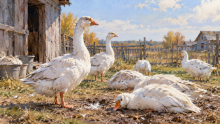
As FBRK wrote earlier, in the village of Shakhovskoye in the Kyzylzhar district of the NKR, a mass die-off of domestic geese has begun again. According to villagers, roughly a third of the flock has already died. Tests for avian influenza, Newcastle disease, salmonellosis and pasteurellosis returned negative results.
Professor Gaisa Absatirov recalls that this is far from the first episode of poultry die-off. In 2020, at the Bishkul poultry factory in the NKR, more than 180,000 laying hens died in a single day, and in 2025, the die-off of geese and chickens was recorded in the Pavlodar Region and again in the NKR.
WHAT VERSION OF THE DISEASE THE EXPERT NAMES
The professor suggests that the committee comprehensively study integrated diagnostics - epizootological, clinical, pathoanatomical and laboratory.
In his opinion, the symptoms resemble the velogenic (acute) course of Newcastle disease: a short incubation period, depression, weakness, diarrhoea and nervous system disorders - uncoordinated gait, convulsions, twisting of the neck.
Among the pathoanatomical signs, he names haemorrhages in the excretory ducts of the glands of the proventriculus, at the border of the proventriculus and gizzard, in the duodenum and the small intestine.
WHAT ABSATIROV STOOD UP FOR BEFORE THE DEPARTMENT
In the same post on his personal Facebook page, the professor suggested that the CVCS leadership stop the "systematic psychological harassment" of Yeris Nuraliyev - a candidate of biological sciences whose dissertation was devoted to methods of veterinary-sanitary measures at a poultry factory.
Absatirov notes that Nuraliyev successfully tested treatment regimens used in poultry farming in Kazakhstan and CIS countries, in particular the administration of the preparation "Ecocid S" in drinking water and its spraying on poultry for upper respiratory tract lesions. The professor suggests including the expert in the epizootological survey group.
HOW THE DEPARTMENT REACTED TO SUCH SIGNALS
The history of Nuraliyev's conflict with the CVCS leadership has been going on for more than a month. FBRK wrote earlier that back at the beginning of 2026 he sent official memos to the committee chairman Kazbek Tashimov about the threat of the spread of dangerous infections, but his initiatives, according to him, remained unanswered, and soon his own position was cut.
The committee later replied to FBRK that restrictions on the import of livestock from Russia had been in effect since 13 January 2026, and the disinfection of transport at the border, which the expert had proposed, came into operation on 11 March. At that time, two internal investigations were being conducted into Nuraliyev himself.
WHAT THIS MEANS
The story of the goose die-off in the NKR looks less and less like an isolated veterinary failure. On the one hand - a department that time and again faces mass death of poultry (and not only) and ultimately signs off on the diagnosis with the wording "unknown disease". On the other - its own specialists, whose warnings and alternative versions result in internal inquiries and pressure.
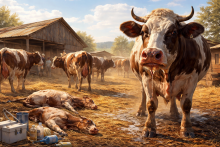
Incidentally, the "unknown disease" in Kazakhstan has lately been affecting almost all domestic and wild animals: saigas, cattle in several regions at once, as well as small ruminants. Convenient. After all, compensation to the affected owners is often refused.
The result is a paradoxical system: the cause of the disease remains unknown, yet with those who try to find it, everything somehow turns out to be far clearer. And if this is not an accident but a sustained practice, then what is at stake is not only problems in veterinary diagnostics, but also the quality of the department's own work.