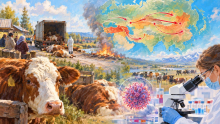
Recently FBRK reported on the introduction of a state of emergency in the Oyok district of Russia's Irkutsk region due to an outbreak of lumpy skin disease in cattle. In the days since, the situation has only worsened. Experts suspect the animals have foot-and-mouth disease, one female resident attempted to take her own life in protest, and farmers have released a petition demanding documents confirming the animals' diagnosis.
Meanwhile, in Kazakhstan, Professor Gaisa Absatirov has announced a new outbreak of an "unknown disease" - this time among sheep - and has once again drawn attention to the silence of the relevant authorities.
HOW THE CONFLICT IN BUTYRKI AND KOTY ESCALATED
Recall that on 4 September, a state of emergency was declared across the entire Oyok administrative district due to an outbreak of lumpy skin disease in cattle.
On 6 September, residents of the villages of Butyrki and Koty reported the forced seizure of livestock for subsequent destruction. According to them, visibly healthy animals were also taken. The Telegram channel "People of Baikal", citing local residents, writes that the day before, veterinarians had declared these same animals healthy during an examination.
The Governor of the Irkutsk region, Igor Kobzev, confirmed that by 6 September the disease had been detected in 96 animals in Butyrki and Koty, and that the infected livestock would have to be destroyed, promising to discuss compensation separately.
On 7 September, one of the female residents of the villages where the livestock culling is taking place attempted to take her own life in protest. The woman was pulled from the noose in time and taken to hospital.
WHY TALK OF FOOT-AND-MOUTH DISEASE EMERGED
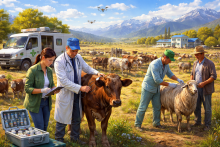
St Petersburg veterinary epizootologist Svetlana Shchepyotkina stated that the symptoms in some of the animals could indicate foot-and-mouth disease. According to her, during the house-to-house visits, doctors did not change their hazmat suits after examining disease hotspots and went on to check healthy animals in the same suits.
A resident of Butyrki named Anna had a cow that was healthy before the examination, but the next day it began salivating profusely - a symptom that had also been recorded earlier this year in the Novosibirsk region, where it subsequently became known that there was a foot-and-mouth disease outbreak under the official diagnosis of "pasteurellosis".
On 8 September, 19 animals - 14 cows and five pigs - were taken from Butyrki and Koty for incineration. Owners were promised compensation of 304 roubles (around 1,640 tenge) per kilogram of live weight for cows, 308 roubles (1,661 tenge) for small ruminants, and 190 roubles (1,025 tenge) for pigs.
In total, hotspots were identified at 25 farms in the Irkutsk district, and 146 animals are to be seized.
Livestock owners from the Irkutsk region have launched a petition to the regional prosecutor's office.
Among the key demands are the immediate suspension of the destruction of animals without a documented diagnosis and an individual veterinary examination of each animal being seized.
WHAT KAZAKHSTAN HAS TO DO WITH IT
Uncertainty about the official diagnosis, or even the wording "unknown disease", is not new in this story, and not only in Russia.
Doctor of Veterinary Sciences Gaisa Absatirov wrote on Facebook that last week reports of an outbreak of an "unknown disease" reappeared on social media - this time among sheep. At the same time, the authorised bodies did not react in any way to residents' reports.
According to Absatirov's description, the signs point to nodular dermatitis - a viral disease antigenically related to the sheep pox virus and transmitted mainly by blood-sucking insects.
The professor proposes that the veterinary service begin a "modified stamping-out" - the slaughter of sick animals and ring vaccination in a threatened zone of 10-50 km - and warns that the virus could spread to wild saigas, and therefore cross the country's borders.
FBRK founder and agricultural expert Kirill Pavlov notes that having obtained the status of a country free of foot-and-mouth disease, Kazakhstan has found itself in a rather strange position - it is no longer possible to talk about foot-and-mouth disease, since on paper it does not exist, but it is possible to endlessly churn out "unknown diseases"; the more favourable the epizootic statistics look on paper, the more reluctant the authorities are to rush with diagnoses.
One can only guess whether Kazakhstan is destined to repeat the experience of its northern neighbours.