A public conflict has flared up in recent months around the semi-captive saiga breeding centre in the Korgalzhyn district of the Akmola region. The trigger was statements made by hunter Batyr Seikenov, who questioned the legality of certain aspects of the project's implementation. The editorial board of the FB RK examined the documents, visited the centre's territory, and compared the public statements with the available facts.
WHAT IS KNOWN ABOUT THE CENTRE
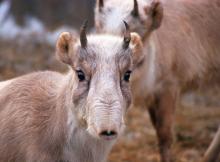
The project in the Korgalzhyn district represents the largest centre for semi-captive saiga breeding in Kazakhstan. On a territory of 1,800 hectares, an enclosure complex has been created, housing the breeding stock of animals captured in May. Alongside its scientific component, the project is seen as the foundation for the industrial breeding of saigas and the subsequent production of goods derived from their by-products.
It is this project that became the subject of public debate following a series of statements by Batyr Seikenov, questioning certain aspects of its implementation. The editorial board of the FB RK investigated what is known about these claims and to what extent they are supported by documents.
BACKGROUND TO THE CONFLICT
The conflict between Seikenov and people associated with the project is not new. In August 2023, following a trip to the Korgalzhyn district, an incident involving a firearm occurred. According to Seikenov's account, this was an attempted murder. However, the pre-trial investigation into this incident was registered as hooliganism and was subsequently closed due to the absence of a criminal offence. Nearly three years later, in the context of the current dispute over the centre, Seikenov has once again publicly referred to this episode as an attempt on his life.
On 12 May 2026, the Department of Natural Resources and Environmental Management of the Akmola region issued LLP 'Scientific and Production Centre for Animal Husbandry and Veterinary Medicine' permission to capture 250 saigas (20 males and 230 females) for scientific purposes in the Korgalzhyn district. The capture was conducted from 13 to 18 May.
On 22 May, according to Batyr Seikenov, he travelled to the centre's enclosure and found no animals inside, but also recorded a damaged section of the fencing.
At the end of June, he published a video of a dead saiga near the centre's territory and sent appeals to the Prosecutor General's Office, the National Security Committee, and other state bodies.
FACTUAL BASIS
According to data available to the editorial board, the actual capture took place within the specified timeframe without losses – no animal deaths were recorded during the removal stage.
After the capture, the animals were placed in the quarantine enclosure of the farm centre owned by LLP 'Central Asia Billion Grain International Trade Co., Ltd' in the Korgalzhyn district.
Among the founders of LLP 'Central Asia Billion Grain International Trade Co., Ltd' are a foreign company and the Kazakh LLP 'Sonlight-Eurasia', whose director is Liu Zulyang. The land user of the centre's territory is a separate legal entity, LLP 'AgroExport LTD', represented by Serik Rakhimbayev. The project has received letters of support from local and regional state bodies at various stages.
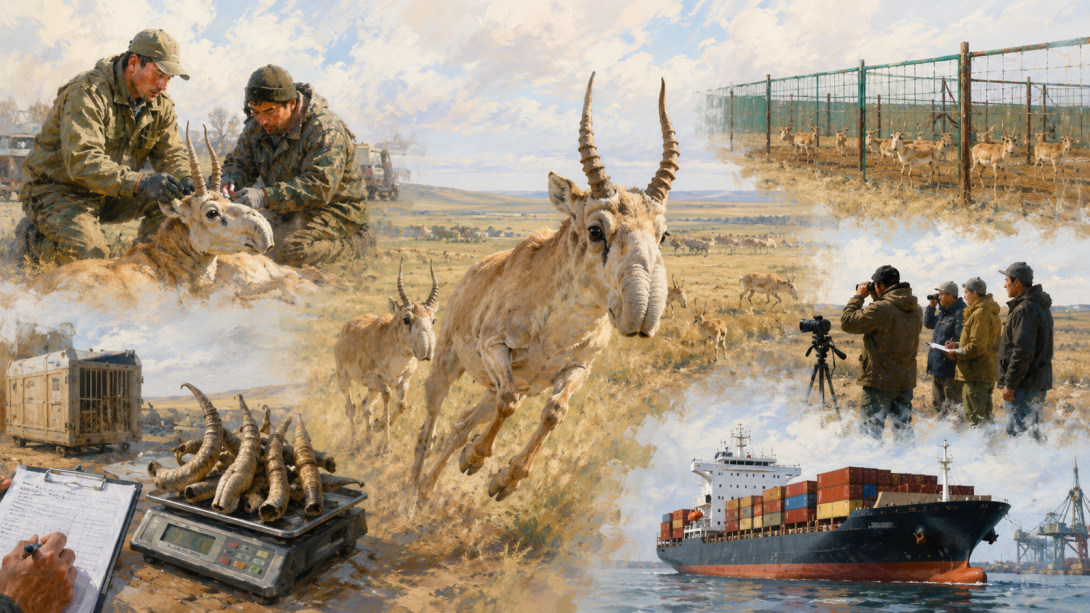
The project involves not only a scientific but also a commercial component. In December 2025, Kazakhstan received approval from the Convention on International Trade in Endangered Species of Wild Fauna and Flora (CITES) to export saiga horns for a period of three years with a total limit of 30 tonnes. According to data available to the FB RK editorial board, the company has been corresponding with the Ministry of Ecology and Natural Resources of the Republic of Kazakhstan regarding the supply of raw materials for the production of canned goods, medicinal raw materials, hides, and fur – meaning that, parallel to the removal for scientific purposes, a commercial track related to the future export of derivatives is also being developed.
ANALYSIS OF SEIKENOV'S CLAIMS
After reviewing the documents, the editorial board separately verified Batyr Seikenov's main public assertions. His key claim was that in 2026, only two organisations received licences for saiga removal: RSE 'Institute of Zoology' and LLP 'Ecobiogen'.
In a telephone conversation with an FB RK journalist, Seikenov changed the source of this information three times: first – 'open data', then – verbal information from 'owners of hunting grounds', then – a response from some scientific centre which he could not provide. Ultimately, the only document that Seikenov provided to the editorial board after the conversation was that very permission, issued to a third organisation. This document directly contradicts Seikenov's initial claim about 'two organisations'.
In addition to the permission, Seikenov provided the editorial board with standard notifications from the eOtinish portal stating that his appeals (to the NSC, MIA, Prosecutor General's Office, and Ministry of Ecology) were being processed by the relevant departments. These notifications merely confirm the fact that an appeal was registered and contain no assessment of its validity. During the conversation, Seikenov interpreted the lack of a substantive response from the departments as indirect confirmation of his correctness – an argument not supported by direct evidence.
Separately, Seikenov claims that the head of the company and some of the founders are foreigners, and that the owner of the land is LLP 'Sonlight-Eurasia'. According to data available to the FB RK editorial board, this organisation does indeed appear in the company's structure as one of the founders; however, the land user of the territory is a separate legal entity, not 'Sonlight-Eurasia' directly – meaning Seikenov's phrasing is inaccurate in detail, although the direction is correct.
Seikenov published a video of a dead saiga, dating it to the end of June 2026 – that is, more than a month after the completion of the capture, during which no losses were recorded. The cause of the animal's death, the number of dead individuals, and the results of any possible veterinary examination have not been made public. On 22 May, according to Seikenov, he saw no saigas in the enclosure and recorded a damaged section of fencing; however, he himself does not have access to the territory and cannot confirm what was happening with the animals during that period.
In the conversation with the FB RK journalist, Seikenov put forward another point: the mere fact of fencing the territory (in his estimation, 24–26 km of perimeter) means a violation regarding wild animals – marmots, foxes, roe deer – which physically cannot leave the fenced area, regardless of the permit status for saigas.
WHY THESE CLAIMS REQUIRED FURTHER VERIFICATION
The FB RK has repeatedly covered Batyr Seikenov's public statements related to wildlife protection issues. In several instances, the editorial board sent requests to state bodies or compared the statements with official documents.
For example, in 2024, after Seikenov published information about an allegedly planned licensed saiga hunt for foreign tourists, the Ministry of Ecology officially stated that such a hunt did not take place. Another subject of FB RK publications was Seikenov's conflict with the Institute of Zoology regarding the biological justification for regulating saiga numbers – a dispute that later went to court.
This context in itself neither confirms nor refutes Seikenov's current statements. However, it is precisely for this reason that the editorial board decided, in this instance as well, to verify each of the allegations made against documents and participant comments.
In addition to the mentioned cases, the editorial board became aware of other court proceedings involving Seikenov – against a former police chief of Arkalyk and against LLP 'Leader Stroy 2002'. Seikenov's public activity regularly leads to conflicts, some of which end up in court. A detailed analysis of the outcomes of these cases is planned by the FB RK for a separate article.
POSSIBLE CONSEQUENCES
If the allocation of quotas for saiga capture in the Akmola region in 2026 is not officially commented on by the relevant department, the conflict surrounding the centre risks continuing to develop in the public sphere through videos and statements from the parties involved, rather than through verifiable documents.
For the project itself, which aims for the legal export of derivatives through the CITES mechanism, the reputational risks associated with unsubstantiated allegations could be significant when building an international trade chain, which under the convention's terms requires transparency and traceability of supplies.
CONCLUSION
At present, Seikenov's key claim that only two organisations received licences for saiga removal in 2026 is refuted by the document he himself provided to the editorial board.
Some of his other assertions – regarding the ownership structure, and the fenced territory as a form of poaching against wild animals – are either inaccurate in detail or require separate verification. The cause of death of the saiga in his video, the exact structure of quota allocation across the region, and the official position of the centre itself remain open questions.
At the same time, the project itself is being implemented with the knowledge of state bodies and in compliance with the requirements of international organisations: the capture permit was issued through the official portal, the centre's activities are accompanied by correspondence with the relevant ministry, and the prospect of exporting derivatives is linked to the international CITES mechanism. Seikenov's public statements to date are not supported by documents – the only material evidence remains video recordings and emotional comments on social media.