In the Akkol district of the Akmola region, residents complained for several months about two problems at once: the pungent smell from a new hide processing plant and the construction of veterinary facilities that, apparently, didn't even have formal land rights.
The editorial team of FBRK studied the official responses from the akimat, police, and relevant departments to these complaints and found that some of the grievances have already been confirmed by the state bodies themselves: the plant has been fined, its operations suspended, and the relevant department itself is seeking a court order to revoke the environmental permit that allowed the enterprise to operate.
AGRO PROTEIN PLANT
The cattle hide processing enterprise - Agro Protein LLP - opened in Akkol on 29 September 2025. Almost immediately, residents of neighbouring quarters began complaining about a persistent unpleasant odour.
After several months of complaints, the Akmola region akimat officially confirmed that the smell was not accidental, but a consequence of the plant operating without some of the required documents.
In the response to an appeal from Akkol resident and activist Shorman Iskakov, it is stated verbatim:
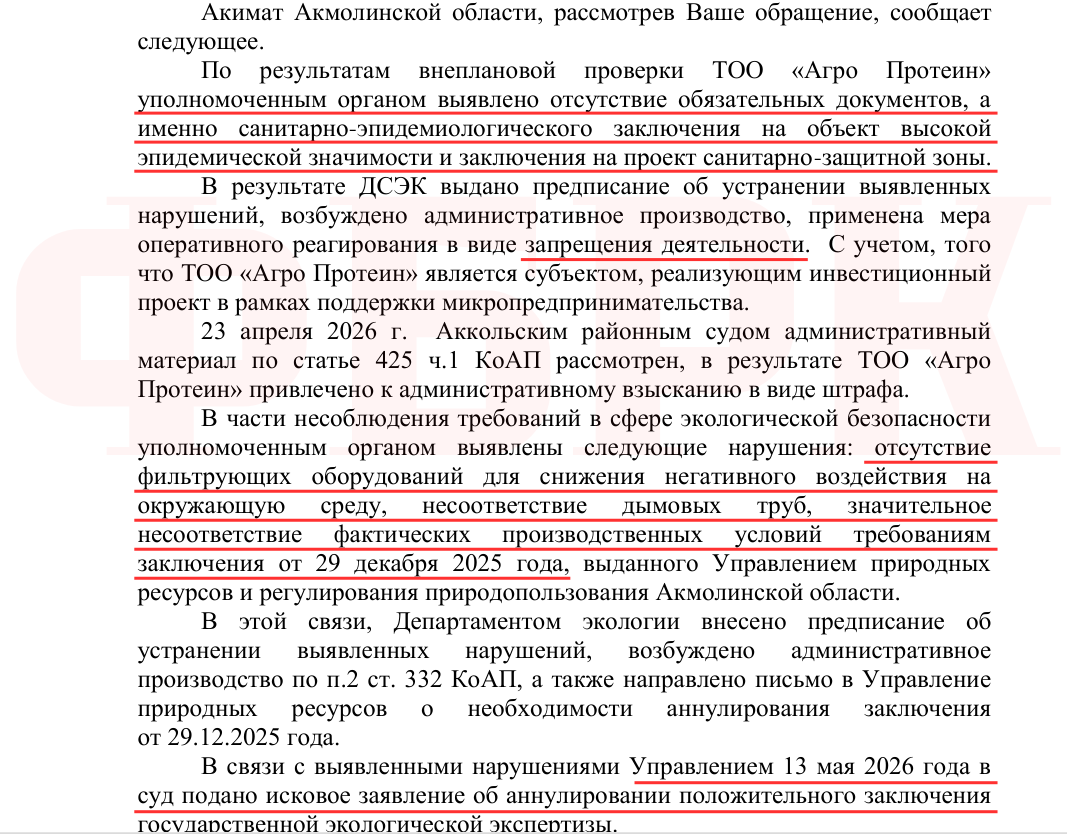
"Following an unscheduled inspection of Agro Protein LLP, the authorised body identified the absence of mandatory documents, namely a sanitary-epidemiological conclusion for a facility of high epidemic significance and a conclusion for the design of a sanitary protection zone."
Based on the inspection results:
- The Department of Sanitary and Epidemiological Control issued an order and suspended the plant's operations;
- On 23 April 2026, the Akkol District Court fined Agro Protein LLP under Article 425, Part 1 of the Administrative Code of the Republic of Kazakhstan "Violation of legislation requirements in the field of sanitary and epidemiological welfare of the population, as well as hygienic standards" in the amount of 484,400 tenge;
- The inspection revealed the absence of filtering equipment, non-compliance of chimney stacks, and "a significant discrepancy between actual production conditions" and the environmental conclusion issued on 29 December 2025;
- On 13 May 2026, the Department of Natural Resources of the Akmola region filed a lawsuit seeking the cancellation of this environmental conclusion - meaning the departmental body is pushing for the annulment of its own permit allowing the plant to operate.
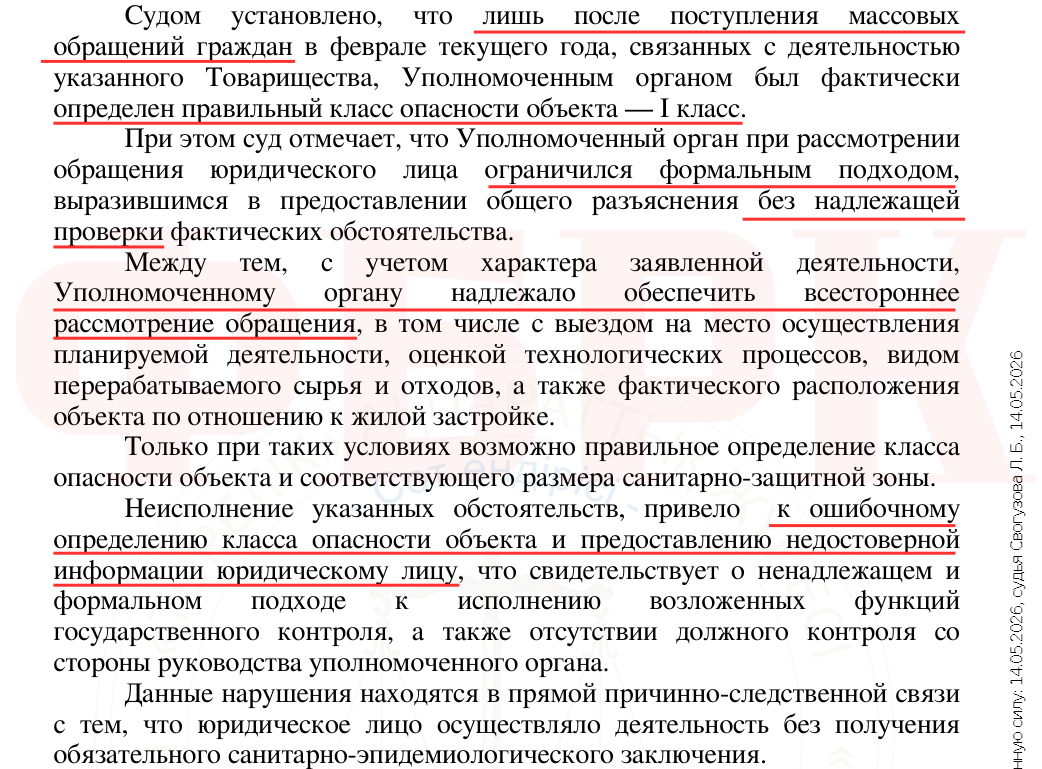
During the administrative case proceedings, the court also drew attention to the actions of the sanitary-epidemiological service. In a private ruling, it was stated that when considering the enterprise's application, the authorised body used a formalistic approach and did not verify the actual circumstances, although it should have assessed the technological process, the type of raw materials processed, and the location of the facility relative to residential areas. The court pointed out the violations of legality committed by the department's management and suggested considering disciplinary action against the officials involved.
This creates a strange sequence: the expert assessment that allowed the plant to operate was issued in December 2025, and by May 2026, the same department is asking the court to cancel it. Below, we examine how the residents themselves and an independent expert they consulted explain this discrepancy.
VETERINARY FACILITIES
Alongside the story of the plant, another conflict was unfolding in Akkol - the construction of burial pits for livestock carcasses without formal land rights.
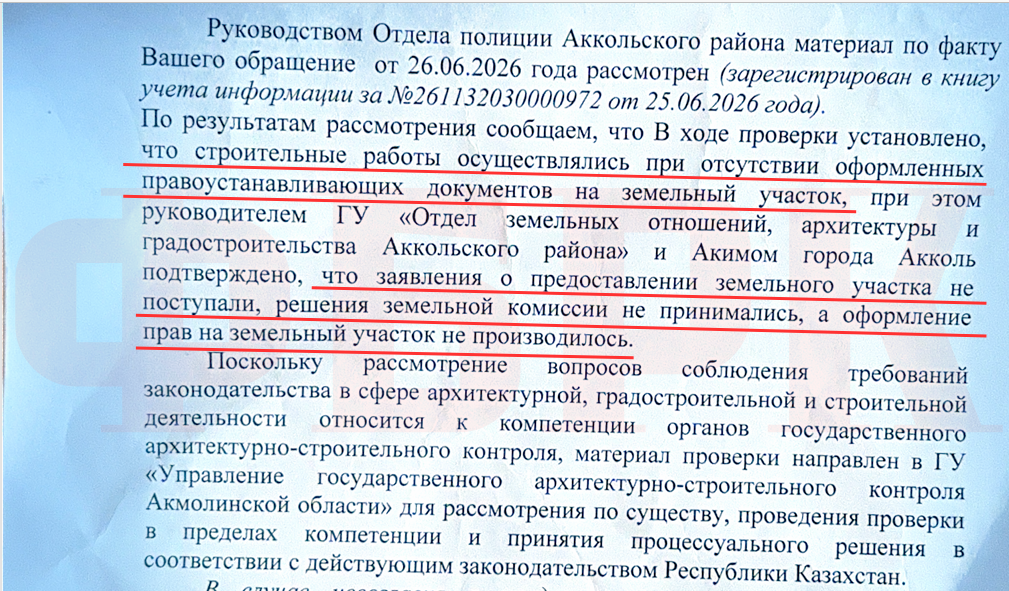
According to documents available to the FBRK editorial team, the Akkol District Police Department reported that construction work was being carried out without formalised title documents for the land plot.
At the same time, the Mayor of Akkol and the head of the land relations department clarified that applications for land allocation had not been submitted at all, and the land commission had made no decisions. It was reported that materials related to this episode have been sent to the architectural and construction control authorities.
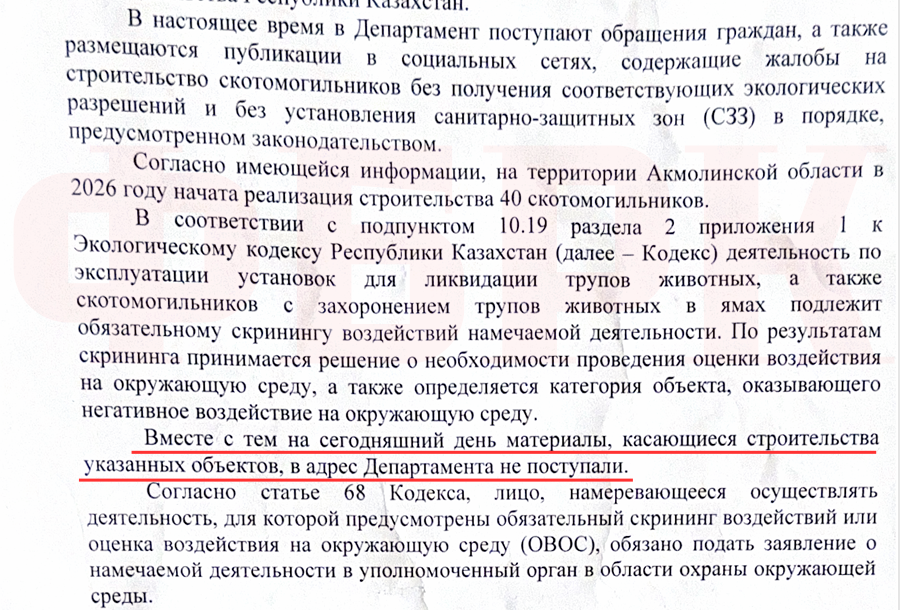
The Department of Ecology of the Akmola Region confirmed the scale in a separate letter: in 2026, the construction of 40 livestock burial pits was started in the region, while "materials concerning the construction of these facilities were not submitted to the Department" - meaning the legally required environmental screening for these facilities was simply not carried out.
Why did this happen? The regional Department of Veterinary Medicine explained the scheme for implementing such projects: construction is carried out by a private developer using their own funds, and the state "acquires the facility only after its construction is completed... that is, it acts as a buyer of ready-made property, rather than the initiator (customer) of the construction."
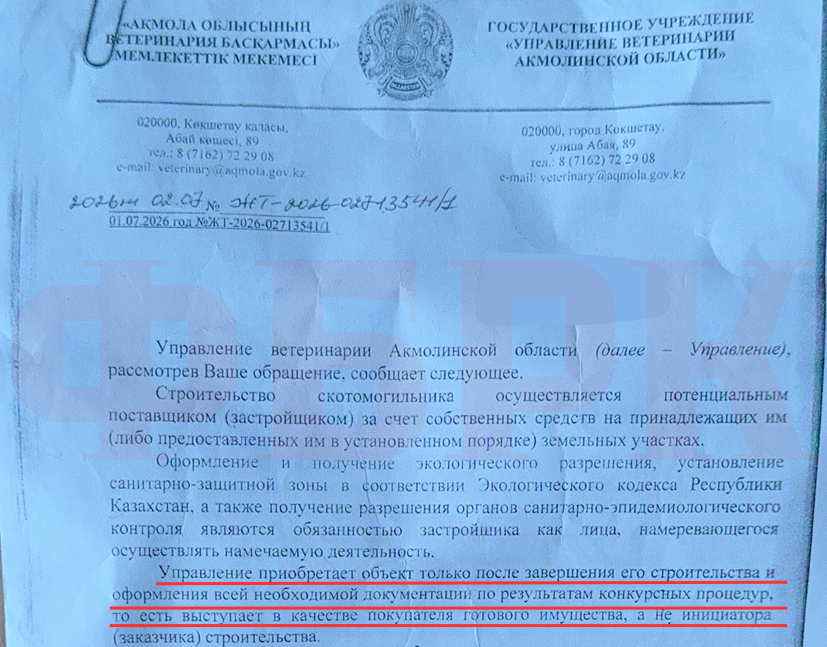
In other words, while a private individual, rather than the state customer itself, builds the facility, some of the control procedures mandatory for state construction projects are formally not applied to it. The department does not deny the existence of this scheme - it merely insists on its legality.
MANURE STORAGE FACILITY
Following the same scheme - "buy ready-made, don't order and control" - another controversial structure appeared in the district: a manure storage facility. According to official data, a plot of 10 hectares for storing poultry waste belongs to Akkol Kus LLP. The akimat reports that the plot was purchased at an open auction in January 2025, is located within the boundaries of the village of Dombynaly, does not belong to the state forest fund, and its placement was pre-agreed with the local community.
Residents, however, insist that the actual waste storage is happening not quite where it was agreed upon.
CONTEXT AND BACKGROUND
All three complaints - about the plant, the livestock burial pits, and the manure storage facility - were submitted by the same Akkol resident and activist, Shorman Iskakov: over several months, he wrote official appeals to all relevant departments and received the responses quoted above.
According to activist Iskakov, the director of the Agro Protein plant, Askhat Madiev, is the brother of the First Deputy Mayor of the Akkol District, Kenzhetay Sayat, who oversees industry and chairs the district's land commission - that is, the very body which, according to police data, did not consider the application for land allocation for the veterinary facility.
This family connection is independently confirmed by an article in the media. Sayat himself, in comments to journalists, did not deny the relationship but explained his actions through procedural authority. According to him, the akimat is obliged to support all investors regardless of who they are. Madiev, for his part, publicly stated that there were no violations on the enterprise's premises.
The question that this family connection alone does not answer is: how did the plant ultimately obtain a positive environmental conclusion if, according to inspection data, the actual production conditions did not match it?
Enter ecologist Bulat Esekin, who participated in drafting Kazakhstan's first environmental laws. According to residents, he pointed out a specific procedural failure during the expert review: the project submitted for approval stated that there were no residential buildings nearby, whereas in fact they are within a couple of hundred metres of the plant. In his opinion, this explains why the expert assessment was issued at all - the commission evaluated a project that did not reflect the real situation on the ground. The exact distance to the residential buildings remains a point of dispute: the plant director himself gives a different figure.
The court later pointed out some of these circumstances, noting that when determining the hazard class of the facility, the authorised body did not verify the actual location of the enterprise relative to residential development and limited itself to a formal examination of the application.
WHY THIS ISN'T JUST A STORY ABOUT ONE PLANT
Both narratives - the plant and the livestock burial pits - came to light for the same reason: not through planned oversight, but only after residents began to complain. The formal procedural approvals were passed on paper: the plant had an environmental expert assessment, and the veterinary programme had the status of an official state project. But in both cases, it turned out that the paperwork did not match what was happening on the ground.
Later, the court separately indicated that one of the causes of the situation was an inadequate inspection by the authorised body, which incorrectly determined the hazard class of the facility and provided the enterprise with inaccurate explanations.
This shifts the question from "was there a permit?" to "how was it obtained given these indicators?" - and here, Esekin's version about distorted data in the application becomes key: it explains the mechanism, rather than just pointing out the fact of a violation. With the veterinary facilities, the story is simpler and cruder: there were no permit documents at all, and the very "state buys ready-made" scheme removes the construction phase from the oversight that would have applied if the state had been the direct customer.
WHAT'S NEXT
The future of the plant depends on the outcome of the lawsuit seeking to revoke the expert assessment. Even if the court grants the motion to cancel the environmental conclusion, the main question will remain unanswered: how was it issued to the enterprise given the violations discovered later? For the veterinary facilities, the risk is different - the "buy ready-made" scheme could allow the remaining programme facilities to be completed without environmental screening, as long as no new complaints are lodged about each one individually.
EDITORIAL OPINION
The established facts - the fine, the suspension of the plant's operations, the department's lawsuit to cancel its own expert assessment, the absence of formal land rights for the veterinary facility - point not so much to a single violator, but to a weakness in oversight specifically at the permit issuance stage: residents' complaints proved more effective than planned supervision. The question of the role of local officials' family connections in this story is not directly confirmed by documents and requires their official position.
FBRK examines a similar story - a company that received significant state support and faced similar issues with permitting procedures and obligations - in another region in the article - SK Protein LLP Project Found at Centre of Legal Disputes After Receiving State Support.