A long-distance lorry driver from Shchuchinsk, Ivan Chekulaev, has received 16 years' imprisonment in Georgia for 56 tilidine tablets, a painkiller prescribed to him by German doctors. The verdict has not yet entered into force. But even now this story raises a broader question than a single criminal case: what the Kazakh state actually does for its citizens when they end up on trial abroad. FBK previously reported on this case in a special YouTube episode.
WHAT IVAN CHEKULAEV WAS CONVICTED OF
On 22 April 2026, customs at the port of Poti inspected a lorry that had arrived by ferry from Romania the day before. According to the verdict, when a customs officer asked about medicines, Ivan replied that he was carrying a preparation for personal use and himself took a bag out of a holdall in the cab. In it was a box of Tilidin comp STADA 100 mg: five full blister packs and a sixth with 6 tablets remaining.
An expert examination counted 5.6 grammes of tilidine in them. Ivan was charged under two articles of the Criminal Code of Georgia: the acquisition and storage of narcotic substances in especially large quantities (Art. 260) and their importation (Art. 262). On 24 April the court remanded him in custody, refusing bail set at 10,000 lari.
On 8 October the Poti City Court found Ivan guilty and sentenced him to 16 years' imprisonment, as well as a 5-year ban on driving. The verdict can be appealed to the Kutaisi Court of Appeal within a month. According to Ivan's wife, on 30 October Ivan received a translation of the verdict into Russian, and an appeal was filed the same day. According to the family, Kazakhstan's honorary consul in Georgia, Irakli Kakaladze, helped file it. The family could not afford to hire a paid lawyer. The wife has no documents confirming that the appeal was filed.
The same verdict indicates that Ivan was not charged with distribution. The tablets were in their factory packaging with the patient information leaflet, the search of the vehicle and personal search yielded nothing further, and he has no previous convictions. The court took into account in his favour that he did not resist and voluntarily handed over the preparation.
Tilidine had indeed been prescribed to Ivan. In September 2024, a neurosurgeon at the Klinikum Fulda confirmed he had an intervertebral disc hernia and recommended tilidine 50 mg for severe pain. Six months before that, according to the family, Ivan's leg gave way while he was on a run.

WHY IN GEORGIA A PAINKILLER BECAME AN "ESPECIALLY LARGE QUANTITY"
In Germany, tilidine is dispensed by prescription. The verdict cites a response from the German police obtained via Interpol: simple possession of such a preparation for personal use is not a crime there. In Georgia, tilidine is on the list of narcotic substances, and the especially large quantity threshold for it starts at 1 gramme. The penalty under the importation article ranges from 15 to 20 years or life imprisonment.
At the same time, Georgian law does not prohibit importing such medicines. According to the verdict, this requires a prescription with a certified translation into English, a doctor's certificate and a document confirming their authenticity. Ivan did not have these documents with him.
The Georgian court can impose less than 15 years only if the accused admits guilt and concludes a procedural agreement with the prosecutor: a term plus a fine. A letter from the Ministry of Foreign Affairs (MFA) of the Republic of Kazakhstan to Ivan's wife lists the options discussed in court on 7 September: 5 years and 150,000 lari, 6 years and 100,000 lari or 9 years and 25,000 lari. None of them was concluded. According to the wife, over six months the family went through several lawyers, and the terms of the agreement she was quoted kept changing and were never put in writing.
WEAK SPOTS IN THE CASE THAT CANNOT BE AVOIDED
There are questions in this story that no one can answer today. The clinic's report specifies a dosage of 50 mg, but the tablets seized were 100 mg. According to the verdict, the defence did not submit other medical documents, and Ivan's explanations of where he obtained the preparation were inconsistent. The editorial team does not consider it possible to assess these circumstances in place of the court. But they cannot be passed over in silence either.
It was precisely these gaps that proved decisive. The MFA letter states that after the hearing on 30 July, the prosecutor explained to the consul that a suspended sentence and an agreement with a fine could be expected only if the Prosecutor General of Georgia were approached with official confirmation of the origin of the prescription and the preparation. No such confirmation appeared. Whether anyone tried to obtain it from Germany is not stated in the government bodies' responses.
WHAT THE KAZAKH STATE DID
According to the MFA itself, the embassy learned of the detention on 23 April and helped find a lawyer at that time. The Georgian side did not respond to a request for a meeting with the detainee. The first visit by consul Olzhas Ilyusizov took place on 29 July, more than three months after the arrest. Other visits are not mentioned in the ministry's documents. According to the family, there were no other visits to Ivan.
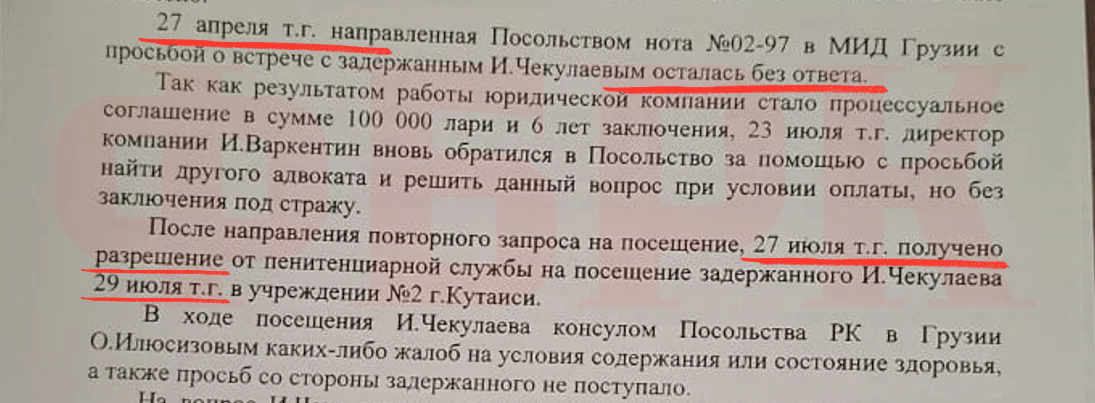
The consul's report on that meeting records that Ivan made no complaints about conditions of detention or his state of health. The family tells a different story. According to the wife, for almost six months Ivan wore the clothes he was detained in: the belongings from the lorry cab were never passed on to him, and clothing had to be found through acquaintances in Georgia. It was eventually handed over with the consulate's involvement. According to the family, a neurosurgeon was called to see Ivan in prison.
When the FBK editorial team put questions to them, the result was a chain of referrals. The Presidential Administration and the Prosecutor General's Office (PGO) of the Republic of Kazakhstan forwarded the requests to the MFA. The consul in writing directed us to the press service.
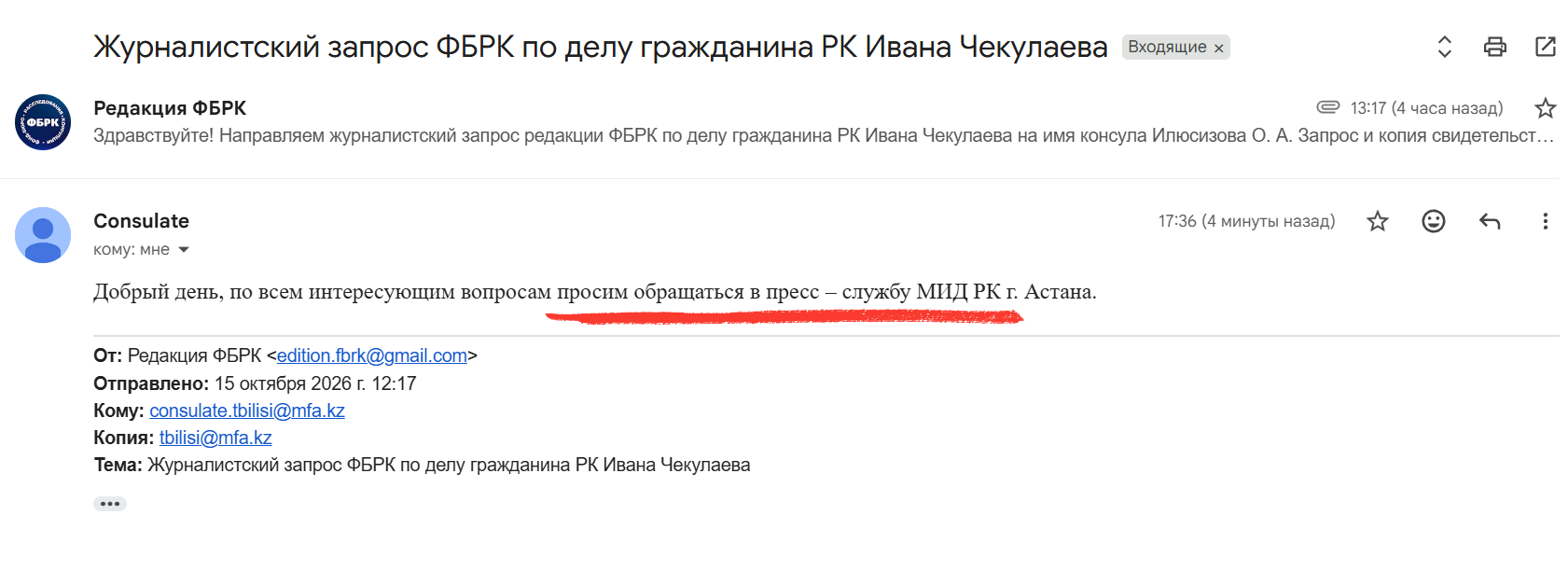
The MFA's first response contained neither dates nor a position on the verdict. In the second, the ministry recommended contacting Ivan Chekulaev's wife for details. A request to Scania-Borovoe LLP, where Ivan worked, went unanswered.
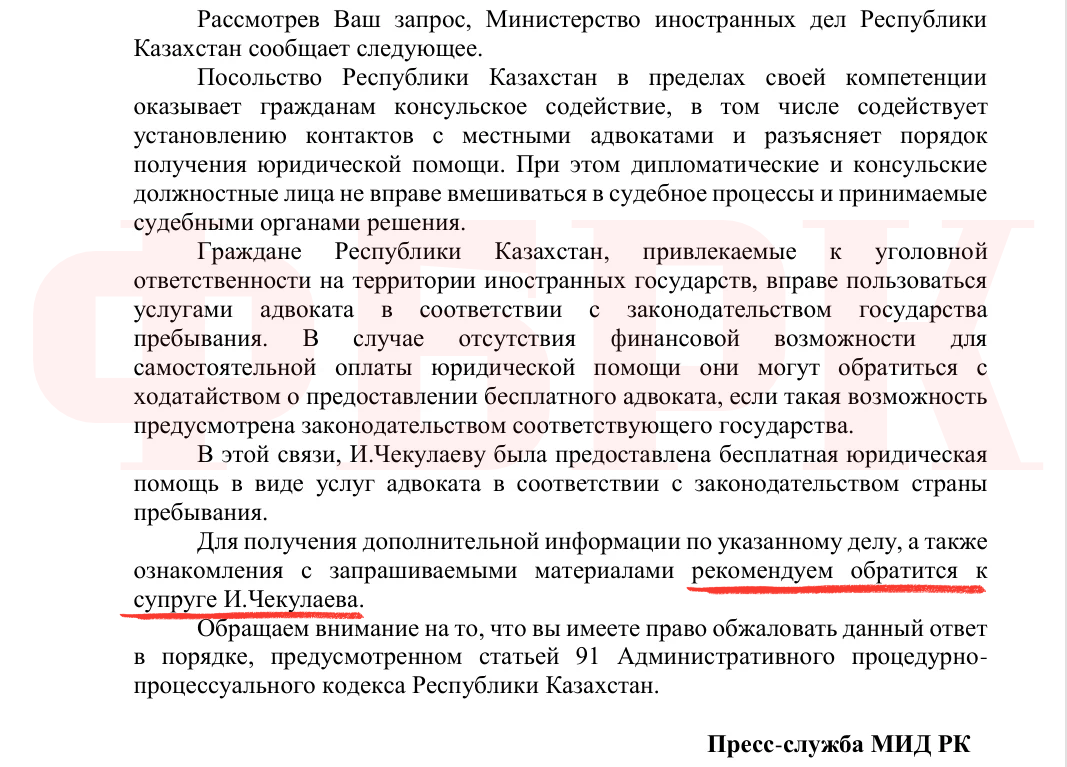
It is important to distinguish: the embassy indeed has no right to interfere in the work of a Georgian court, and the MFA refers to this directly. But the editorial team's questions concerned not the court but consular work: when Ivan was visited, whether he had a defence lawyer at every hearing, whether the verdict was served on him. There is no substantive answer to these. The last question turned out not to be a formality: if, according to the family, Ivan received the translation of the verdict only on 30 October, he had less than two weeks to prepare an appeal. Whether this complies with the requirements of Georgian law and whether the embassy was aware of it - the editorial team will send a separate request.
WHAT AWAITS IVAN AND WHY IT CONCERNS MORE THAN HIS FAMILY
Now it is up to the appellate court. If the verdict is upheld, Ivan will have two options. The first - transfer to Kazakhstan to serve his sentence, which requires a verdict that has entered into force and the consent of the convicted person, Georgia and Kazakhstan. The second - a pardon. In both cases, the initiative and persistence of the Kazakh side are decisive. So far the MFA has confined itself to a phrase that such mechanisms are "subject to consideration where the relevant legal grounds exist".
Beyond a family tragedy, this story concerns every Kazakh citizen who carries medicines across a border, and especially long-distance lorry drivers. A painkiller bought at a pharmacy in one country can become grounds for a long sentence in another. The editorial team has no data on how many Kazakh citizens are currently on trial in Georgia under similar articles. However, if consular assistance in such cases amounts to a single visit and the forwarding of questions, the risk of similar stories recurring remains.
THE EDITORIAL TEAM'S VIEW
We do not presume to judge whether the Georgian court's verdict is lawful; that is a matter for the appeal. But the documents show that the outcome of the case largely depended on whether the origin of the medicine could be officially confirmed. And it is precisely here that the family was left alone with a foreign judicial system, changing lawyers and oral terms of deals. Consular assistance, judging by the government bodies' responses, amounted to a formal minimum. The editorial team believes the state should answer not the question of whether the case is being monitored, but the question of what specifically has been done and will be done so that its citizen receives full protection and a chance to return home.
CONCLUSION
Ivan Chekulaev's case is not over. The FBK editorial team has filed complaints about both MFA responses; they are due to be considered in the second half of November. The main question remains open: what the Kazakh side will do after the appeal if the sentence stays the same.
FBK continues to follow the situation.