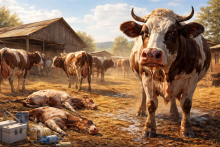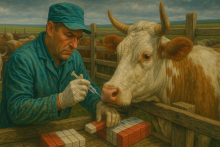
Residents of the villages of Butyrki and Koty in the Irkutsk municipal district of Russia gathered to hear from local authorities why their livestock will be culled. The answer came from the head of the district, Leonid Frolov: the situation is "critical", and the cause of the outbreak of lumpy skin disease is said to be the illegal import of small ruminants.
For the Irkutsk region, this is not the first such crisis, and for Russia as a whole, the outbreak fits into a far more alarming picture, given that since the beginning of 2026 a wave of mass livestock culls has swept across the country, some of which, as FBRK has established, may have been masking a far more dangerous disease - foot-and-mouth disease.
HOW THE EVENTS UNFOLDED IN THE OEK ADMINISTRATIVE DISTRICT
The first restrictions in the district were introduced back on 3 September. At that point, there were two infected farms in Butyrki, holding 21 animals. Within a day, on 4 September, the situation had deteriorated so much that the administration declared a state of emergency across the entire Oek administrative district of the Irkutsk region.
By 5 September 2026, the number of epizootic hotspots in Butyrki and Koty had grown to eight.
Lumpy skin disease is a viral illness that primarily affects cattle (bovine animals). It causes fever, skin nodules, a drop in milk yield and reproductive disorders, and in severe cases leads to the death of animals. The virus is not transmitted to humans.
According to data from the World Organisation for Animal Health (WOAH), its spread is facilitated by blood-sucking insects and the movement of infected livestock, while early detection of hotspots, movement restrictions and vaccination help combat the disease.
WHAT LOCAL AUTHORITIES ARE SAYING
The governor of the Irkutsk region, Igor Kobzev, and the deputy chairman of the regional government, Vladimir Chitorkin, came to the meeting with residents. The head of the district, Leonid Frolov, acknowledged people's anger over the impending destruction of livestock, but asked them not to obstruct veterinary measures.
According to him, the administration has already identified a site for the disposal of animals and has prepared combustible materials and equipment, with work proceeding according to the regional veterinary service's plan and the instructions of the anti-epizootic commission. Specialists continue to carry out door-to-door visits to private household plots within the infection hotspot.
The official explanation for the cause of the outbreak is the illegal import of small ruminants into the district.
PREVIOUS OUTBREAKS
The region has already experienced a similar crisis. By the end of March 2024, over 6,000 head of cattle had been destroyed in the region because of the same disease. And since February 2026, authorities in the Novosibirsk and Omsk regions, the Altai Republic and a number of other regions have been destroying livestock, ostensibly because of mutated pasteurellosis and rabies.
Yet the protocol applied - destroying all susceptible animals within a 5 km radius of the hotspot and burning the carcasses - corresponded not to pasteurellosis at all, but to the fight against foot-and-mouth disease. Experts noted that livestock owners were refused independent testing and were not given their test results. Officials in Novosibirsk publicly denied foot-and-mouth disease.
However, as FBRK established based on an internal report from the Siberian Interregional Directorate of Rosselkhoznadzor, foot-and-mouth disease was in fact detected in the Cherepanovsky district of the Novosibirsk region - as early as 16 January, with laboratory confirmation received on 24 January. A laboratory in Vladimir identified the SAT1 subtype.
According to the same report, more than 2.6 million kg of infected raw milk had already been sent for processing to enterprises in the Altai Krai, the Omsk and Novosibirsk regions, and around 4,000 head of livestock had been preliminarily earmarked for destruction.
Russian authorities never officially called the disease by its real name.
This habit, as Professor Gaisa Absatirov says, is also characteristic of our own regulatory agencies. The diagnosis of an "unknown disease" is now being given with increasing frequency in Kazakhstani veterinary medicine.
The professor ironically suggests naming such diseases, which are "unknown" to our veterinary services, after the geography of the outbreak, and calls the disputed diagnoses made by the chairman of the veterinary control and supervision committee of the Ministry of Agriculture of the Republic of Kazakhstan, Kazbek Tashimov, "Tashimov's disease".