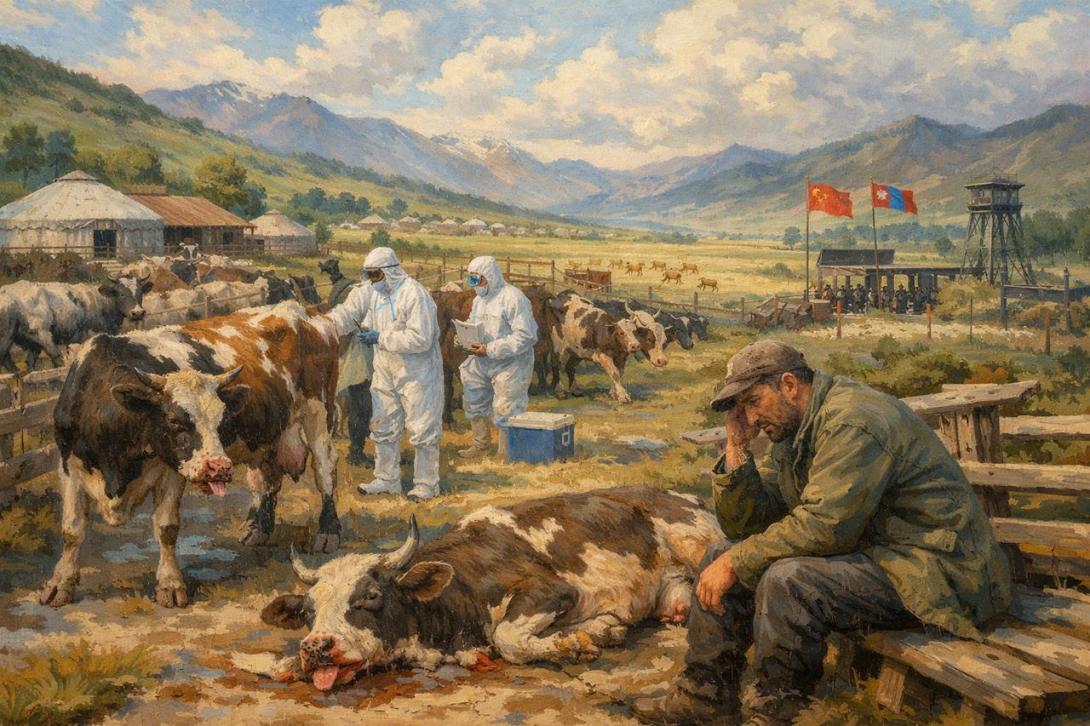
While international organisations openly speak about a new and extremely dangerous serotype of foot-and-mouth disease, threatening the livestock of an entire continent, in Kazakhstan the relevant authorities continue to deny any link to any strain of this disease. The FAO report effectively confirms what farmers in the West Kazakhstan Region and independent experts have been saying for months: the virus against which existing vaccines are ineffective is no longer a supposition, but a reality in countries neighbouring Kazakhstan.
WHAT THE FAO REPORTS
According to data from the Food and Agriculture Organization of the United Nations (FAO), official notifications from China and Mongolia (in April and May respectively) have confirmed the spread of a new serotype of the foot-and-mouth disease virus (SAT1) in East Asia. Livestock in South and Southeast Asia has no immunity to the new strain, and the vaccines used in the region are not effective against it, the organisation notes.
The FAO is allocating $400,000 under its Technical Cooperation Programme to Cambodia, Indonesia, Laos, Pakistan, the Philippines, Thailand and Vietnam for early detection and laboratory diagnosis. On 18 June, together with the World Organisation for Animal Health (WOAH), a special session of the Regional Expert Group on Foot-and-Mouth Disease is being convened.
WHY THIS CONCERNS KAZAKHSTAN
It is worth recalling that the same serotype SAT1 previously appeared in an internal report by the Russian Federal Service for Veterinary and Phytosanitary Surveillance (Rosselkhoznadzor) regarding an outbreak in Novosibirsk Oblast and in China's notification of an outbreak in Gansu Province and the Xinjiang Uyghur Autonomous Region — right on the border with Kazakhstan. FBRK wrote about this back in April, and later reported on thousands of livestock showing symptoms characteristic of foot-and-mouth disease in the West Kazakhstan Region. The Ministry of Agriculture (MoA) officially does not confirm the diagnosis of foot-and-mouth disease in saiga antelope and livestock, and the country maintains its status as free from foot-and-mouth disease.
WHAT THE THREAT IS
The FAO estimates potential annual production losses in the region at $5–6 billion under a moderate outbreak scenario — not including trade disruptions and response costs. For smaller individual economies, losses could reach 0.5-1% of GDP.
It is also worth recalling that the independent analytical company Geobox Inc. previously published scenario modelling of foot-and-mouth disease outbreaks. The analysis covered 201 districts of Kazakhstan over a 180-day horizon.
The model's authors calculated three scenarios. In the absence of any intervention, a potential foot-and-mouth disease outbreak by week 25 would affect between 14.3 and 23.1 million animals. Even with early containment (ring culling at week 2), the figure would be up to 21.2 million head. The critical window for intervention is from week 2 to week 8. After week 12, all scenarios without an effective vaccine converge to the same outcome.
The vaccine held in national stockpiles covers foot-and-mouth disease serotypes O, A and Asia-1. If the strain turns out to be SAT-1, every animal in the country is considered fully susceptible, and no culling will change the situation; a different vaccine would need to be procured.
If your farm has been affected by the "unknown disease" or you have information on the subject, you can send materials to our anonymous bot @fund_kz_bot.