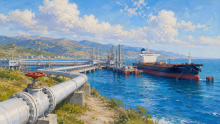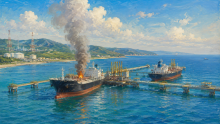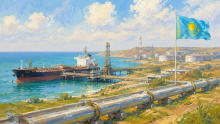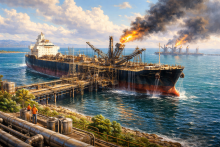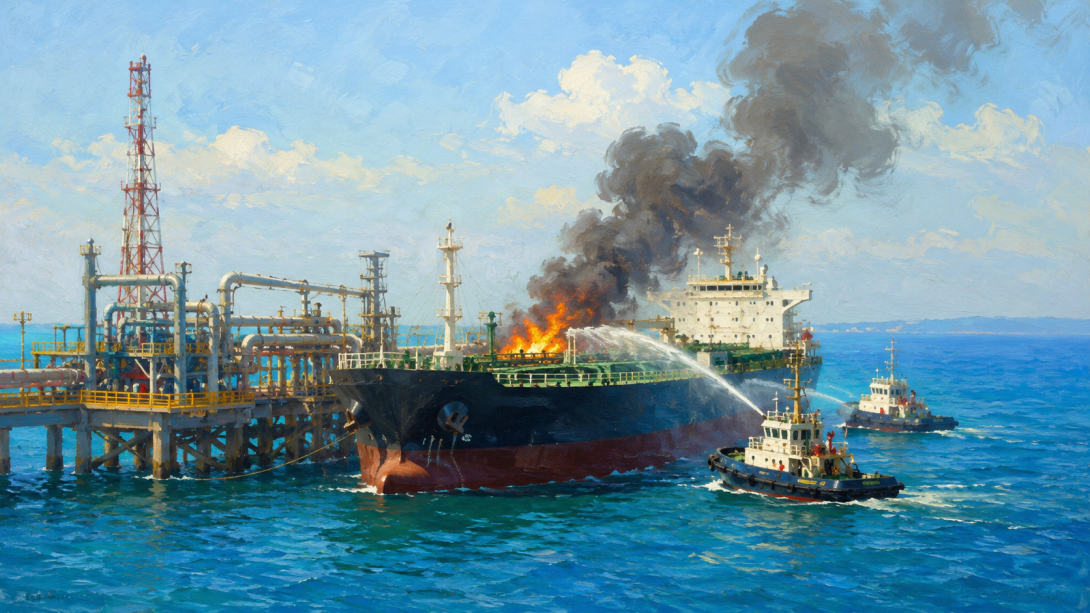
Tanker NIFFOS SIFNOS, which was loading oil at the offshore mooring facility of the Caspian Pipeline Consortium (CPC), was attacked using unmanned aerial vehicles (UAVs). As a result of the ensuing fire, there were no casualties and no oil spill occurred.
WHAT HAPPENED
According to the CPC, on 30 July 2026, the tanker NIFFOS SIFNOS, sailing under the flag of the Marshall Islands and with the shipper being Tengizchevroil LLP (Chevron), was attacked while loading oil at the offshore mooring facility OMF-3.
As a result of the UAV attack, a fire broke out in the area of the oil reception manifolds on the cargo deck. The fire was extinguished by the tanker's crew with the assistance of three CPC support vessels.
WHAT ARE THE CONSEQUENCES OF THE ATTACK
According to CPC, there were no casualties or fatalities among consortium employees or contractor personnel. No oil spill occurred. No medical assistance or evacuation of crew members was required.
The tanker remained afloat. An assessment of the damage sustained is currently underway. Oil loading has been stopped, while the pipeline facilities continue to operate as normal.
In addition, another tanker — the MARATHI, sailing under the flag of the Isle of Man and heading to the terminal to load oil — was attacked in territorial waters approximately 6 nautical miles from the CPC Marine Terminal.
WHAT THE CPC SAID
The CPC stated that, in their assessment, the attack was carried out despite previously voiced calls from the Republic of Kazakhstan and other foreign shareholders of the consortium, including through the US State Department, to avoid the use of force against international energy infrastructure facilities.
The statement also noted that, according to the CPC's assessment, such attacks create risks for international trade in energy resources, affecting the economic interests of the Republic of Kazakhstan, the CPC's western shareholders, and shipper companies, among them Chevron, ExxonMobil, Eni, Total and Shell. Furthermore, the CPC highlighted potential environmental risks to the waters of the Black Sea in the event of damage to a tanker and a possible oil spill.
CONTEXT AND SIGNIFICANCE
On 19 July 2026, during oil loading at the CPC Marine Terminal, tankers ASIA and NISSOS IOS were attacked. A fire broke out on the tanker ASIA, which was quickly extinguished. No casualties or oil spill were reported, but loading was temporarily suspended.
The Ministry of Foreign Affairs (MFA) and the Ministry of Energy condemned the attacks on the tankers, emphasising that such actions pose a threat to the safety of crews and international energy infrastructure.
On 21 July 2026, Kazakhstan halted the pumping of oil to the CPC Marine Terminal in the Russian port of Novorossiysk following a series of attacks on tankers. The terminal stopped receiving oil via the pipeline as shipping companies were reluctant to send vessels to the area.
It later emerged that oil production in Kazakhstan decreased after the shutdown of the export terminal on the Black Sea, through which the majority of Kazakh oil supplies pass. The most significant reduction was recorded at the Tengiz field.
On 27 July 2026, the CPC resumed receiving oil from shippers and operations for its shipment via the marine terminal in the port of Novorossiysk.