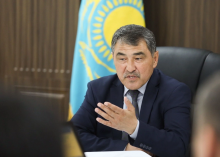
Prime Minister Olzhas Bektenov stated that there are delays in the implementation of a number of projects in the regions and instructed that control over the execution of measures in the sphere of water resources be strengthened. The Government has also set additional tasks for developing the digitalisation of the sector, introducing water-saving technologies and monitoring water quality.
HOW THE NATIONAL INFORMATION SYSTEM WORKS
Vice-Minister of Water Resources and Irrigation Aslan Abdraimov reported that the National Information System for Water Resources is already operational, combining data on water bodies, water management infrastructure, water use and the state of water resources.
The project is being implemented using grant funds from the Eurasian Development Bank without drawing on republican budget funds. The system contains information on 17,758 rivers, 3,148 lakes, 3,927 monitoring wells and 1,209 hydraulic structures. Also added to the digital register are more than 10,000 passports of water management and hydraulic structures, and more than 6,000 reports on special water use have been received.
WHAT PROBLEMS DID THE PRIME MINISTER NOTE
Following the meeting, Olzhas Bektenov emphasised that the implementation of a number of projects in the regions is being delayed. In this regard, regional akimats have been instructed to ensure priority financing for activities assigned to local budgets, as well as to timely allocate the necessary expenditure when forming and adjusting regional budgets.
Furthermore, the Ministry of Water Resources and Irrigation has been instructed to strengthen monitoring of the implementation of the Comprehensive Plan, to more strictly control the timelines and volumes of financing for each activity, and to submit proposals to the Government on problematic issues in a timely manner.
WHAT INSTRUCTIONS WERE THE DEPARTMENTS GIVEN
The Prime Minister instructed to accelerate the introduction of water-saving technologies, noting that this issue is under the special control of the Head of State. Also, the Ministry of Ecology and Natural Resources has been instructed to strengthen water quality monitoring in transboundary rivers.
Together with regional akimats, the Ministry of Water has been instructed to ensure, by 1 January 2027, that passports of hydraulic structures are entered into the National Information System for Water Resources, and by 10 June 2027, to establish the boundaries of water protection zones and strips of surface water bodies within populated areas.
The ministries have also been instructed to ensure data exchange between the National Data Bank on the state of the environment and natural resources and the National Information System for Water Resources.
CONTEXT
It is worth noting that Kazakhstan has a digital system, Tasqyn, designed for flood forecasting. The Ministry of Water has repeatedly stated that the system is in industrial operation, and that based on the results of the 2026 flood period, according to the department's assessment, it generally correctly identified the main forecast trends, despite some deviations in the estimation of water volumes.
At the same time, the FBRK editorial team previously noted that representatives of the ministry could not name the criteria by which the system was accepted into industrial operation, nor did they provide public data on its measurable accuracy. According to the official response from the relevant department, forecast accuracy indicators were not included in the acceptance criteria when Tasqyn was put into industrial operation in 2025.
At a briefing on the digitalisation of the water sector, Aslan Abdraimov also reported that the ministry's digital tools had generated forecasts in advance regarding drought risks in the south of the country and the situation with the filling of the Tasotkel Reservoir. Meanwhile, farmers in the Zhambyl region had complained about a shortage of irrigation water even before the situation received widespread public discussion.
At the same time, Tasqyn is not the only tool for monitoring water risks. Alongside the digital forecasting system, the Ministry of Emergency Situations (MES) continues to use a network of seasonal high-altitude posts for round-the-clock monitoring of the state of moraine lakes.