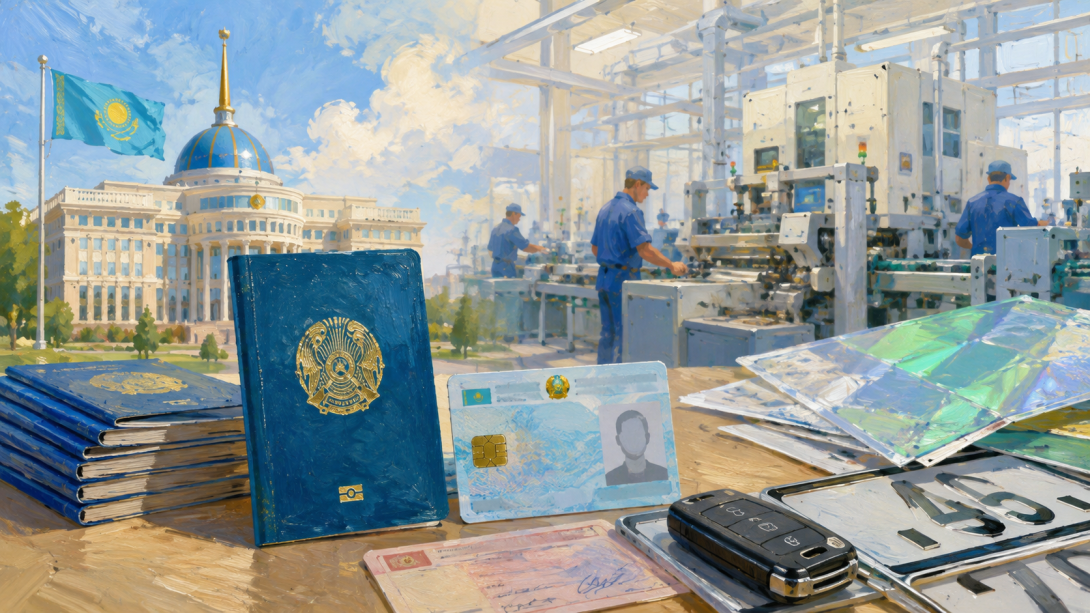
The Information and Production Centre of the Ministry of Internal Affairs (IPC MIA) has announced procurement related to the production of documents totalling more than 24 billion tenge since the beginning of 2026. Among the materials are chip modules, polycarbonate, document paper, fluorescent thread and other components for passports and identity cards.
WHAT THE BILLIONS ARE ALLOCATED FOR
According to BES.media, 12.22 billion tenge has been set aside for materials and equipment for the production of passports and identity cards. A further approximately 12 billion tenge has been allocated for the production and personalisation of driving licences, vehicle registration certificates and state registration number plates.
These are planned procurement amounts, not the final cost of contracts already concluded.
RSE "Information and Production Centre" of the Ministry of Internal Affairs is a subject of the state monopoly. At the same time, passports of Kazakh citizens are produced at the Banknote Factory of the National Bank in Almaty.
WHY PROCUREMENT FOLLOWS A SPECIAL PROCEDURE
Procurement of materials and equipment for the production of documents is carried out under a special procedure. The portal publishes the names of procurements, lot numbers, planned amounts and outcome protocols, while technical specifications and other documents are classified as restricted official information.
Companies submit applications to participate. The organiser indicates in the protocol the potential suppliers, the companies admitted and rejected, as well as those who will be sent notifications for individual lots.
In the procurement of raw materials and consumables for document production, 19 suppliers submitted applications. According to the protocol, none of them were rejected.
WHO WAS AMONG THE POTENTIAL SUPPLIERS
Among the companies planned to be invited to the procurement are enterprises with various business profiles.
For example, United Machinery Resources LLP was planned to be invited to the procurement of fluorescent thread for electronic passports worth 1 billion tenge. The company is registered in Pavlodar and officially engages in the production of automobiles. Previously, its activities also included the production of aircraft.
The list of potential suppliers also includes Sinergy Smart LLP. The company's website lists armoured structures and armour plates, body armour, unmanned aerial systems, anti-drone equipment and security systems.
Other participants are connected to different areas. Kaz-Komir LLP is engaged in the wholesale trade of coal, while SeSta-Alpha-A LLP holds ST-KZ certificates for galvanised barbed wire and "Yegoza"-type barriers. At the same time, the latter company was planned to be invited to supply document paper worth 1 billion tenge.
More directly related to the procured material is Hasm Group LLP, which produces paints, varnishes, enamels and pigments. In the Ministry of Internal Affairs procurement, the company was planned to be invited to supply PVA glue for electronic documents.
HOW THE ECONOMICS OF DOCUMENT PRODUCTION WORKS
According to the audit report for 2025, the IPC's revenue amounted to 28.57 billion tenge, of which approximately 28 billion tenge came from the production of passports, identity cards, driving licences, vehicle registration certificates and state number plates.
The cost of products and services amounted to 27.62 billion tenge.
Expenditure on materials amounted to 17.33 billion tenge, wages for production staff — 3.15 billion tenge, and equipment depreciation — 1.62 billion tenge.
At the end of the year, the IPC posted a net profit of 143.2 million tenge. At the end of 2025, the enterprise's debt to suppliers and contractors stood at 31.05 billion tenge, while stocks of raw materials and supplies were valued at 33.7 billion tenge.
Thus, more than 24 billion tenge in the IPC's 2026 procurement plans relates not only to passports and identity cards, but also to the production of other secured documents.