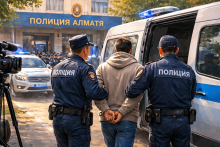
The case of journalist Alexandra Alyokhova has raised questions among media experts and lawyers due to the circumstances surrounding the publication of personal data and the ban on journalistic activity. Specialists were divided in their assessments, but separately drew attention to how, in similar cases, the rules on personal data relate to the professional work of a journalist.
WHY EXPERTS DREW ATTENTION TO THE CASE
According to BES.media, experts consider the key question to be how to assess the publication of information that was already in the public domain before the journalist's material appeared.
Alyokhova's defence argued that the information was obtained from open sources. The Әdil söz Foundation for the Protection of Freedom of Speech also noted that the information had previously appeared in one of the Telegram channels. According to the foundation, no one faced criminal liability for the initial publication, and the law enforcement officer responsible for the leak received a disciplinary sanction.
At the same time, the mere fact that information is in the public domain, according to lawyer Gulmira Birzhanova, does not automatically mean that any further dissemination of it is lawful. However, when assessing a journalist's actions, she said, it is necessary to take into account the circumstances under which the information was obtained and the fact that the publication was part of professional activity.
WHAT THEY SAY ABOUT THE PROPORTIONALITY OF PUNISHMENT TO THE OFFENCE
Birzhanova separately raised the question of whether the ban on engaging in journalistic activity was proportionate. In her view, even if a court establishes a violation, the need for such a restriction should be assessed separately, taking into account the circumstances of the particular case.
The lawyer also considers it important to take into account the provisions of the Law "On Mass Media" and personal data legislation. In her words, a journalist differs from an ordinary user in that they disseminate information as part of their professional activity, so when considering such cases, it is necessary to assess not only the fact of publication itself.
WHY EXPERTS SPEAK OF A PRECEDENT
Director of the International Centre for Journalism MediaNet and founder of Factcheck.kz Adil Dzhaliov called the case an indicator of pressure on Kazakh journalism. In his view, the digital environment makes journalists' work more difficult because a large amount of data is already online, and verifying information does not always make it possible to clearly determine the legal boundaries of its use.
Mazhilis deputy of the VIII convocation and journalist Sergey Ponomaryov also expressed concern about the possible impact of such cases on the profession. At the same time, he stressed that journalists must answer for the accuracy of the information they publish.
HOW THIS COULD AFFECT THE WORK OF JOURNALISTS
In Ponomaryov's view, the situation could make journalists more cautious about handling sensitive stories based on open sources. He also did not rule out that some members of the profession might consider leaving journalism.
Dzhaliov believes that such cases could heighten uncertainty for journalists working with digital information. At the same time, the materials provided contain no data that would make it possible to assess how widely such concerns have already affected the editorial practices of Kazakh media outlets.
CONTEXT
For the record, the Almaly District Court sentenced Alexandra Alyokhova to 3 years of imprisonment with a suspended sentence of 5 years and banned her from engaging in journalistic activity for a period of 3 years.
Minister of Culture and Information Aida Balayeva commented on the verdict, calling for the case to be considered in the appellate instance. According to the minister, the ministry has no right to interfere with the administration of justice.
It later became known that the Almaty prosecutor's office had filed an appeal motion for a lighter sentence for the journalist. The final decision will be made by the court of appeal.