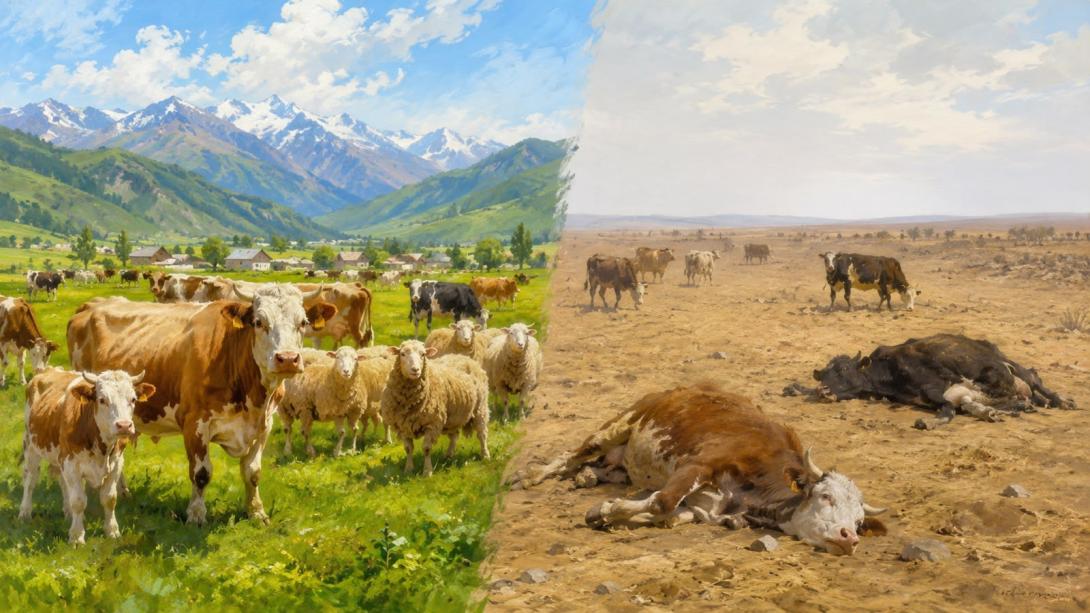
In January–May 2026, Tajikistan produced 85,822 tonnes of meat from large and small livestock, which is 13.4% more than in the same period of 2025. Meanwhile, in Kazakhstan over the same period, livestock mortality for large cattle increased by 18.9%, even though the total herd size grew by 3.9%.
WHAT PRODUCTION FIGURES HAVE BEEN ACHIEVED
According to the Agency for Statistics under the President of the Republic of Tajikistan, in the first five months of 2026, all categories of farms produced 85,822 tonnes of meat from large and small livestock. This is 13.4% higher than the figure for the same period last year.
The largest production increase was recorded in the Sughd Region — by 22.3%. In the cities and districts of republican subordination, the figure rose by 14.3%, in the Khatlon Region — by 8.5%, and in the Gorno-Badakhshan Autonomous Region — by 1.9%.
HOW POULTRY MEAT PRODUCTION CHANGED
In January–May 2026, poultry meat production amounted to 17,922 tonnes, which is 12.4% more than a year earlier.
In the Sughd Region, 9,546 tonnes of poultry meat were produced, a growth of 18.4%. In the cities and districts of republican subordination, 4,552 tonnes were produced (+1.4%), in the Khatlon Region — 3,799 tonnes (+12.6%), and in the Gorno-Badakhshan Autonomous Region — 25 tonnes (+4.3%).
HOW LIVESTOCK NUMBERS CHANGED
As of 1 June 2026, the number of large cattle in Tajikistan had grown to 3.07 million head (+9.4% year-on-year), and sheep and goats to 8.2 million head (+11.6%). The majority of animals are still kept in household farms. An increase in large cattle numbers was recorded in all regions of the country, with the highest in the Sughd Region (+11.4%).
WHAT IS HAPPENING WITH CATTLE IN KAZAKHSTAN
Official statistics in Kazakhstan record the opposite trend. According to the Telegram channel "Posuti", in January–May 2026, the mortality of large cattle was 8,984 head compared to 7,557 head a year earlier. This represents an increase of 18.9%.
At the same time, the total number of large cattle in Kazakhstan over the same period increased by 3.9%. This means that the rise in mortality significantly outpaces the growth in herd size. The statistics themselves do not indicate the reasons for this trend and do not allow conclusions to be drawn about its origin.
WHICH REGIONS OF KAZAKHSTAN STAND OUT
The most notable dynamics were observed in the Kostanay, Pavlodar, and Aktobe regions, the Zhetysu region, and the West Kazakhstan Region. In particular, in the West Kazakhstan Region, the mortality rate rose from 147 to 458 head, i.e., more than threefold.