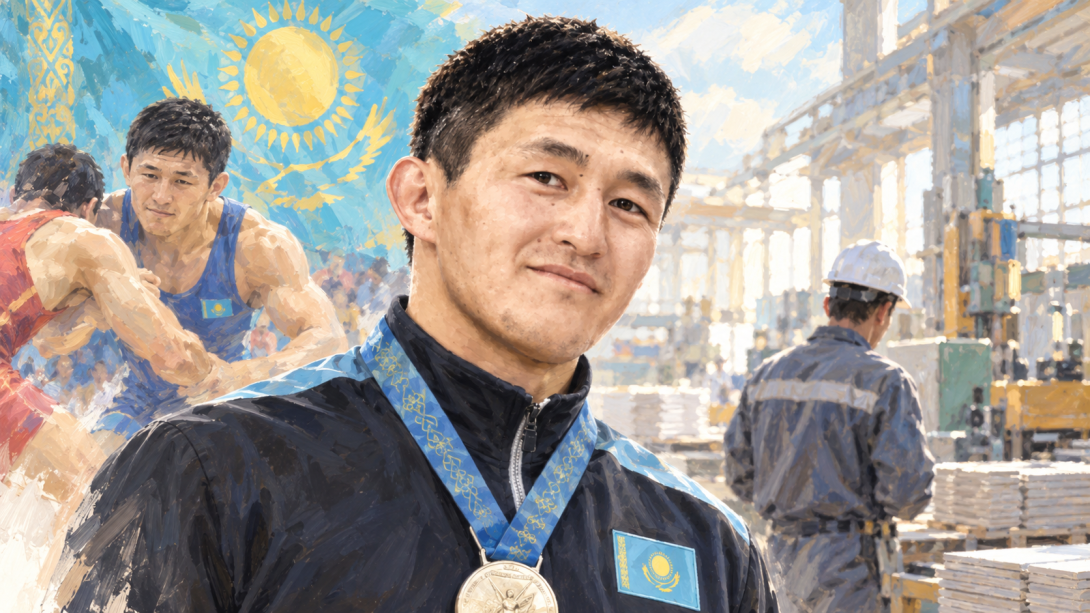
28-year-old champion of Kazakhstan in Greco-Roman wrestling among athletes with hearing impairments Adil Tilektes died on 12 September on the territory of one of the enterprises in Shymkent. According to preliminary data, the man sustained a fatal injury from an electric shock during work.
WHAT IS KNOWN ABOUT THE INCIDENT
According to a friend of the athlete, Adil Tilektes worked at a ceramic tile manufacturing plant. According to him, during work the athlete touched an electrical wire and after the electric shock fell from a height.
The medics who arrived were unable to save him.
WHAT THE POLICE STATED
According to the police department (PD) of the city of Shymkent, a pre-trial investigation has been launched into the death of the worker. The investigative actions are aimed at establishing all the circumstances of what happened.
The police clarified that the man sustained a fatal injury as a result of an electric shock during work. The law enforcement authorities are not disclosing other information, citing Article 201 of the Criminal Procedure Code of the Republic of Kazakhstan.
SPORTING ACHIEVEMENTS OF ADIL TILEKTES
Adil Tilektes practised freestyle and Greco-Roman wrestling and competed among athletes with hearing impairments.
In 2018 he became champion of Kazakhstan in Greco-Roman wrestling in the weight category up to 55 kg. In 2019 the athlete took first place at the team championship of Kazakhstan among adults in the weight category up to 60 kg.
Tilektes also repeatedly became a prize-winner of republican and international competitions. The deceased is survived by his wife and two children.
CONTEXT
We can assume that Adil Tilektes, like many athletes of his level, was forced to combine the status of champion with work that has nothing to do with sport, because medals alone are not enough to feed a family. The republican title, apparently, did not guarantee him a permanent income in sport.
And this is far from an isolated case. Kazakhstani athletes, including those who bring the country medals, regularly find themselves alone with the need to finance themselves — both during their career and after its completion, when state support simply ends.
Earlier, Olympic champion Mikhail Shaidorov spoke publicly about the difficulties of the training system. In an interview after his victory at the 2026 Olympics, he said that from 2022 to 2025 he mainly paid at his own expense for the work of coaches, choreographers, the staging of programmes, costumes and doctors' services. According to the figure skater, he was helped by sponsors, and full conditions from the state appeared only in the Olympic season.
A similar situation was described by Kazakhstani chess player Bibisara Assaubayeva. In 2026 she appealed to the Head of State, stating difficulties with financing preparations for international tournaments. According to the athlete, she paid for her preparations for the Norway Chess tournament from personal prize money and family funds.