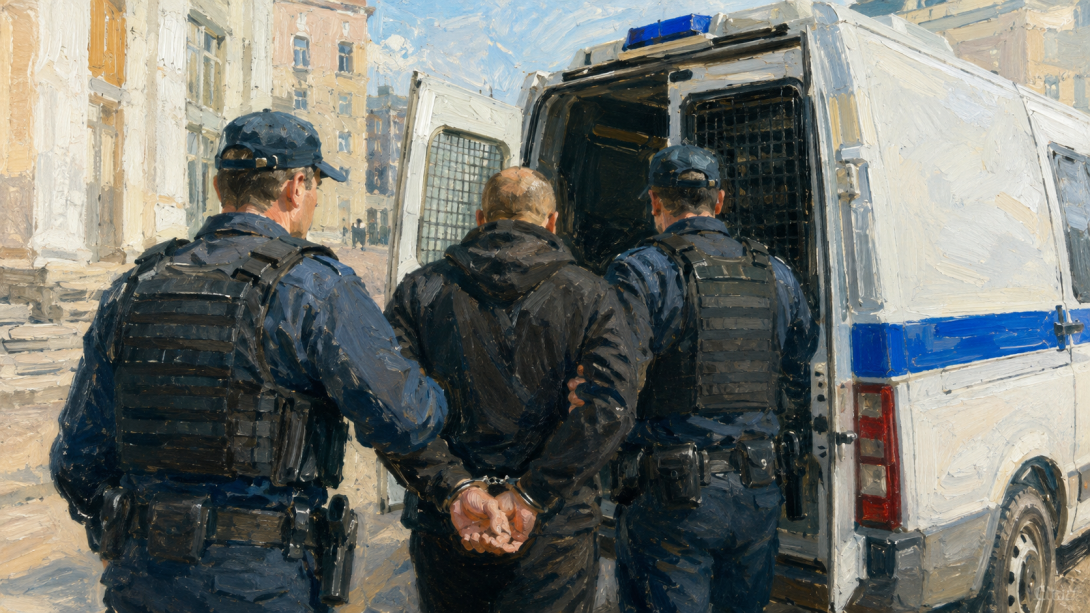
The Financial Monitoring Agency (AFM) has drafted new rules for escorting detainees and persons held in custody. The draft provides for continuous video recording of transport, GPS tracking of special vehicles, a ban on personal phone use by escorts, and three levels of escort.
HOW VIDEO RECORDING OF ESCORTS WILL CHANGE
The draft provides for the mandatory use of body-worn video recorders by the escort team. Recording must begin from the moment a detainee or person held in custody is received and continue until the escort is completed.
Special vehicles are also planned to be fitted with video recorders with audio capture and GPS trackers, with the signal transmitted to the duty station console.
Recordings must be kept for at least 30 days. Materials relating to incidents involving torture and other offences are proposed to be retained until a court sentence comes into legal force or a decision to discontinue the criminal case, approved by the prosecutor, is issued.
Saved data, including the date and time of recording, must not be altered. Access to the archive will be granted only to a designated responsible officer, and backup arrangements are also provided.
WHAT LEVELS OF ESCORT ARE PROVIDED
The draft divides escort into standard, enhanced and special. Under standard mode, one or two detainees are accompanied by two escorts, three to six by three, and seven to ten by seven officers.
Enhanced escort is provided where there is a risk of escape or attack, a threat of harm, as well as for transport between populated areas, by air or by train. Special escort is intended, among others, for suspects and defendants accused of serious and particularly serious crimes who are inclined to escape or attack, as well as for cases that have generated significant public interest.
WHY ESCORTS WILL BE BANNED FROM USING PERSONAL PHONES
While on duty, escorts are prohibited from using mobile phones and other electronic devices. An exception is provided for official communication with the duty officer, management and other authorised officers.
It is also prohibited to disclose the route and final destination, to leave the escort without necessity, or to pass items, notes and food to detainees or receive them from detainees.
WHAT ELSE THE NEW RULES PROVIDE
Before transport, the senior escort officer must ascertain the detainee's state of health. If there are complaints of illness or bodily injury, a medical examination is carried out. If a doctor declares a person unfit to be escorted, they are not accepted.
Men and women, minors, foreign nationals and stateless persons, people with mental health disorders and certain other categories are to be transported separately.
Air travel may be used for routes over 500 km or where it is the only available mode of transport. By rail, only sleeper compartment carriages are permitted; open-plan berth carriages are not provided.
In the event of an escape, the escort must report to the internal affairs authorities on number 102. In AFM buildings and departments of economic investigations (DEIs), the time a detainee may spend in the temporary holding room is limited to three hours.
Compliance with the rules is planned to be checked through scheduled, unscheduled and surprise inspections, with review of the video archive and escort team documentation.