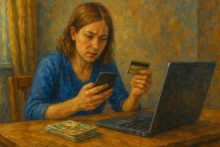
In Almaty, the activities of the payment infrastructure of three online casinos, through which players' money was received and processed, have been shut down. According to the investigation, the scheme used the bank accounts of 16 money mules, into which more than 110 million tenge was deposited.
HOW THE ALLEGED SCHEME WORKED
According to the Agency for Financial Monitoring (AFM), the suspects ensured the operation of the payment infrastructure of the online casinos "Olymp Casino", "Rukh Poker" and "7Kcasino". They received and processed players' funds through the online platform "Rocket.do".
One of the participants in the scheme was a foreign national. He sought out people willing, for a reward of up to $200, to provide access to their bank accounts.
INTO WHOSE ACCOUNTS THE MONEY WAS DEPOSITED
The investigation claims that the individuals recruited were brought to Kazakhstan and accompanied to the Public Service Centre (PSC) to obtain an individual identification number (IIN). They then opened bank accounts.
The suspect gained access to the accounts of 15 foreign nationals, and also provided his own account. As a result, more than 110 million tenge was deposited into the accounts of the 16 money mules from players.
WHAT MEASURES WERE TAKEN AGAINST THE SUSPECTS
One of the suspects has been taken into custody. Three others are under a written undertaking not to leave the place of residence and to behave properly.
The criminal case has been sent to court. No further information is being disclosed in accordance with Article 201 of the Criminal Procedure Code of the Republic of Kazakhstan.
CONTEXT
Previously, the FBRK reported on the schemes surrounding Pin-Up. We wrote about the wanted list for Dmitry Druzhinsky and Marina Levkovich, as well as the detention of blogger Kaysar Kamza and the wanted list for Makhmud Khikmatov.
According to the investigation's version, Dmitry Druzhinsky and Marina Levkovich coordinated the operations of online casinos under the brands "Pin-Up" and "PINCO" through a network of affiliated companies, including Bonami LLP, which obtained a bookmaking licence under the name Pin-Up-KZ. Public figures - in particular, blogger Kaysar Kamza - promoted the casinos to audiences. Makhmud Khikmatov acted as the link between the casinos and influencers.
More than 106.5 billion tenge passed through the payment infrastructure that, according to some media reports, was built by Ilyas Karimov. It is claimed that these funds flowed through fintech companies and acquiring channels, were then converted into cryptocurrency via the Intebix exchange, and were transferred out of Kazakhstan.
Soon afterwards, it became known about the case of Maxim Sigalov, who is suspected of large-scale tax evasion. He owns the non-bank financial institutions Diamond Pay LLC and E-Pay LLC in Ukraine, which provided internet acquiring and payout services for online casinos and bookmakers, including "Ukr Game Technology" (Pin-Up), Vbet and Casino UA.
The funds were laundered through the substitution of transaction codes, payouts to "drop" cards followed by cashing out or conversion into cryptocurrency.