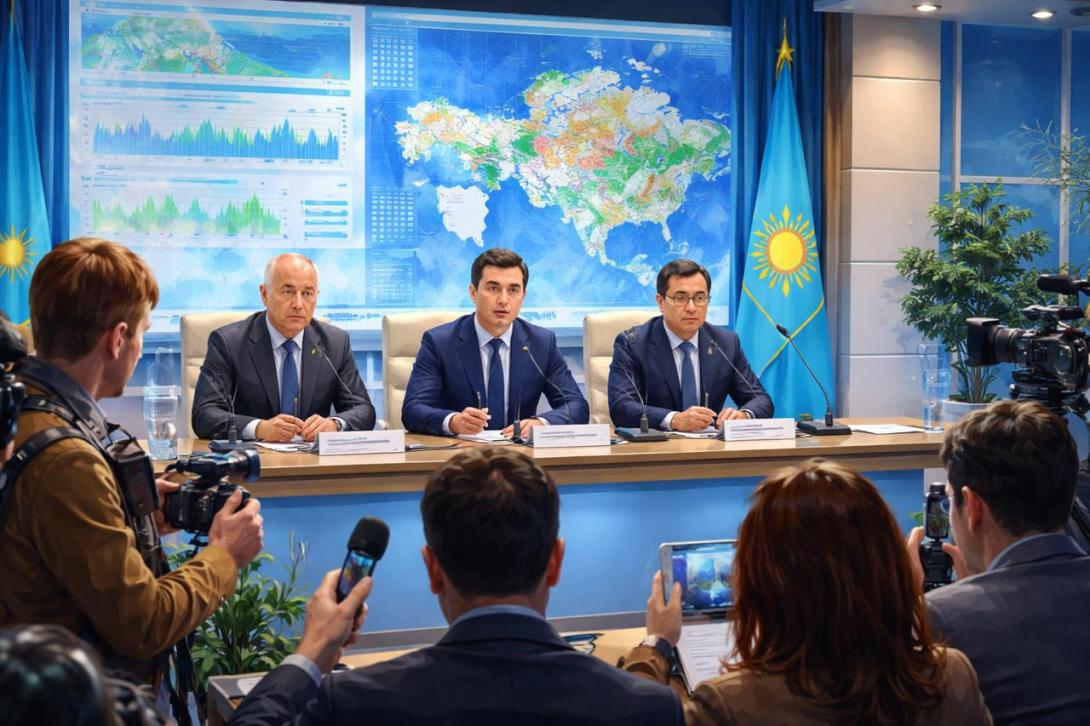
Discussion of the digitalisation of the water industry at a briefing in Astana was accompanied by questions about how effectively the state forecasting systems are working. The focus also fell on the Tasqyn system, but representatives of the Ministry of Water Resources and Irrigation were unable to answer the key question - by what criteria was it accepted into commercial operation.
WHAT WAS DISCUSSED AT THE BRIEFING
On 24 June, a briefing was held at the Central Communications Service (CCS) under the President of the Republic of Kazakhstan on the implementation of measures for digitalisation and automation of water resource management and accounting. The event was attended by the Vice-Minister of Water Resources and Irrigation, Aslan Abdraimov, the Chairman of the Board of the Non-Profit Joint-Stock Company 'Information and Analytical Centre for Water Resources', Khairulla Kairatgali, and the Director of the Digitalisation Department of the ministry, Yerdaulet Zhumat.
The founder of the FBRK, journalist Kirill Pavlov, also took part in the briefing, asking questions about the effectiveness of digital forecasting systems.
WHY QUESTIONS WERE RAISED ABOUT TASQYN
Kirill Pavlov recalled that the Tasqyn system was accepted into commercial operation in February 2025. According to him, based on published data, in 2025 the system identified 182 populated localities as high-risk flooding zones, whereas water actually arrived in only 16 of them (only 14 of this number were recorded in Tasqyn).
The journalist also referred to information about errors in water level forecasting, which, he claimed, reached four metres. In this regard, he asked for the criteria by which the system was accepted into commercial operation, and also requested clarification on who signed the relevant decision.
WHAT THE MINISTRY RESPONDED
Vice-Minister Aslan Abdraimov stated that 2025 was the first full operational period for the system and that digital forecasting tools in Kazakhstan are still undergoing a stage of development.
According to him, criticism of the digital platforms was heard, and following the 2026 flood period, the main forecast trends were determined correctly. At the same time, the Vice-Minister acknowledged the presence of certain deviations in estimates of water volumes. As an argument, he noted the absence of emergency discharges from reservoirs and stated that the expected water volumes were successfully stored.
However, when asked again about the specific parameters for the acceptance of the Tasqyn system, the official did not give a direct answer, advising to contact the Ministry of Artificial Intelligence and Digital Development.
Aslan Abdraimov also noted that the Ministry of Water Resources and Irrigation is merely a user of the system and does not have all the technical parameters of its operation. In this regard, the journalist was advised to seek relevant clarifications directly from the developers.
It will be recalled that the FBRK first attempted to raise the issue of Tasqyn on 10 April 2026 at a briefing of the CCS dedicated to water conservation, but the moderator rejected the question as not relevant to the topic of the event. In turn, the department's written response was limited to describing the functionality of the Tasqyn system, which forecasts floods based on data from 'Kazhydromet'. The ministry did not provide any specific accuracy figures, promising to sum up the results after the flood season.
In a subsequent written response, the Ministry of Water simply clarified that another system, Talsim-NG, is undergoing its first 'combat' season on eight river basins. It is noteworthy that the term 'combat season' in relation to digital forecasting systems regularly recurs in the rhetoric of department representatives.
The editorial board of the FBRK has sent an official request to the Ministry of Artificial Intelligence and Digital Development of the Republic of Kazakhstan to ascertain the technical parameters of the Tasqyn system's operation.