
An arbitration clause is, perhaps, the most underrated provision in Kazakh commercial contracts. It usually gets lost somewhere in the "Dispute Resolution" section, between force majeure and governing law, and businesspeople rarely read it any more carefully than the other formalities. But that is a mistake: by signing it, a party effectively waives recourse to the state courts in favour of a private arbitration institution and the specific arbitrator that institution appoints to hear the dispute.
The editorial team at FBRK investigated the activities of ADAL International Arbitration LLP after businesspeople approached us with doubts about the independence of the arbitrator hearing their case. We are not touching on the substance of their commercial dispute - it is confidential, and we are not at liberty to disclose it. Looking ahead: even while working on this material, it became known that the arbitrator subsequently recused himself from the case - but let us take things in order. The more closely the editorial team examined the very structure of ADAL, the clearer it became: the issue here is far broader than one specific case.
THE FACTUAL BASIS
ADAL International Arbitration LLP was registered on 25 January 2019. According to the Kompra.kz service, in just under seven years the organisation has had no fewer than five directors: Yuri Alexandrovich Lukashevich, Nazima Yerlanovna Saylybayeva, Yersagat Bolatovich Orysayev, Gaziz Abilseitovich Turapbayev, Aralbay Abdilkhay.
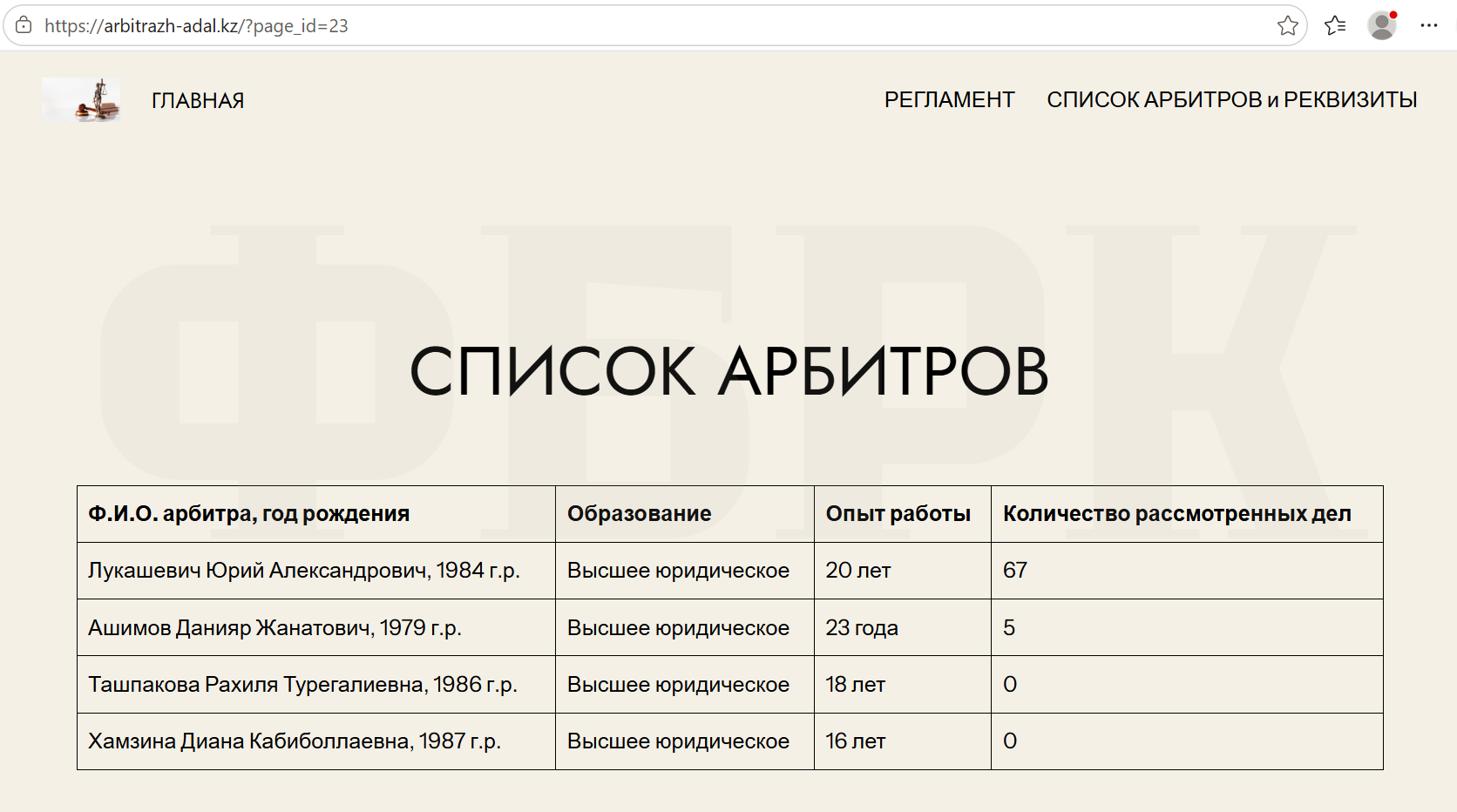
The website arbitrazh-adal.kz publishes a list of four arbitrators. Yuri Lukashevich is listed with 67 cases heard; the other three have 5, 0 and 0. The register contains only year of birth, length of experience and number of cases - without place of work, position or period of employment, even though Article 15 of the Law of the Republic of Kazakhstan "On Arbitration" expressly requires this information to be included in the register of arbitrators made available for public inspection.
Neither ADAL International Arbitration LLP nor Yuri Lukashevich personally appears in the register of the Arbitration Chamber of Kazakhstan - the country's only industry association, which voluntarily monitors the activities of arbitrations.
For comparison: that register lists 21 organisations - from the Arbitration Centre of the Atameken National Chamber of Entrepreneurs to regional arbitrations in Aktobe and Pavlodar, each with its director and contact details. ADAL has chosen to stay off that list.
ADAL's estimated annual revenue was 3.2 million tenge in 2024 and 3.3 million in 2025 - atypically modest for an organisation that positions itself as an international arbitration. The address in the registry data (Turan Avenue, 42) does not match the address on the website itself in the payment details for the arbitration fee (Tauyelsizdik Avenue, 25/1).
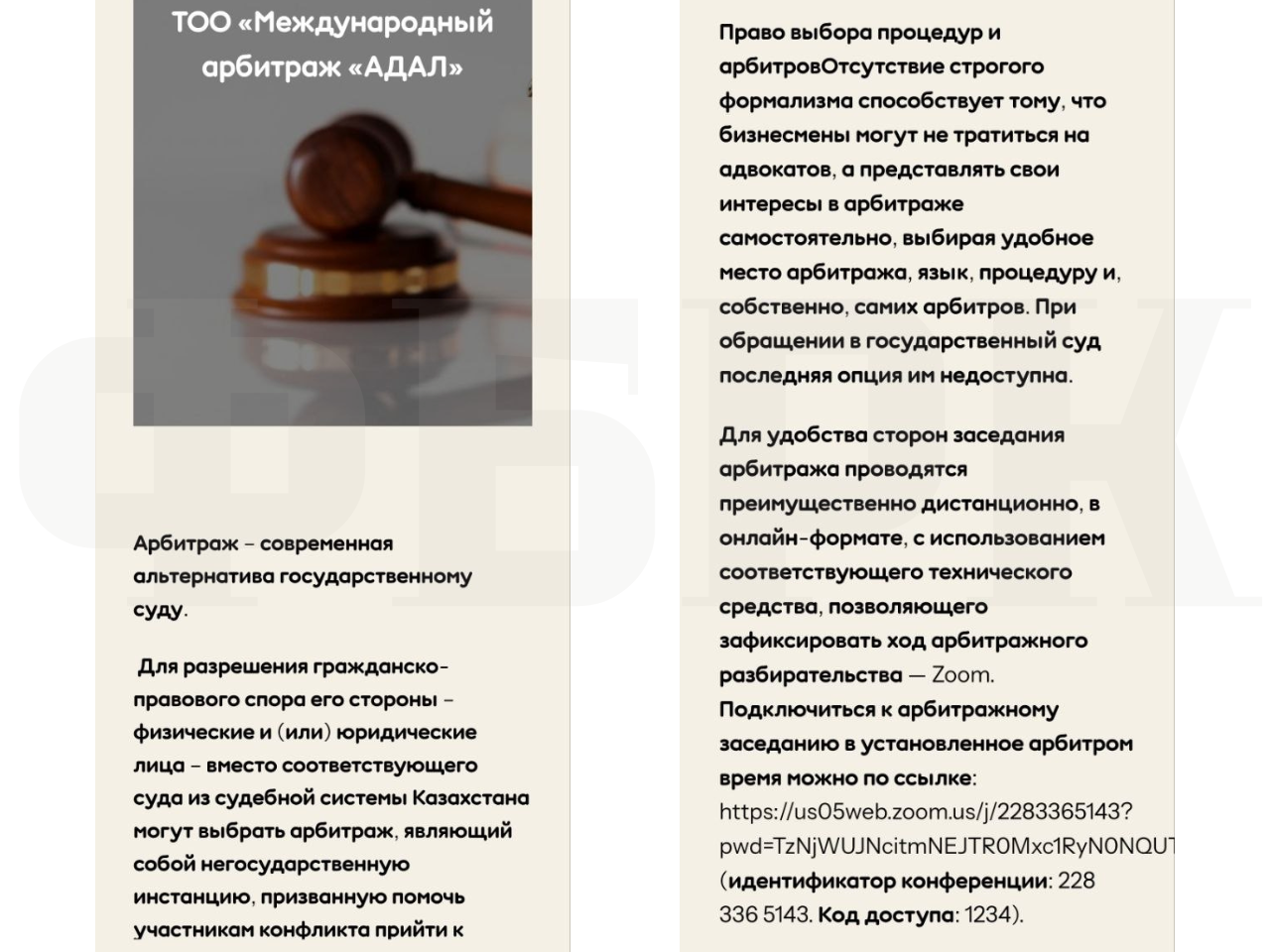
The Zoom videoconference link for arbitration hearings is posted openly on the website along with a permanent access code, valid for all of the organisation's cases.
It was this institution that prompted the editorial team's investigation - after complaints from businesspeople whose commercial dispute was being heard at ADAL. The editorial team is not disclosing the details of the case itself or the parties: the dispute had not been concluded at the time the material was being prepared, and the parties asked that no additional attention be drawn to it. Yuri Lukashevich acted as sole arbitrator in the case. In checking who he is and how he came to occupy that seat, the FBRK editorial team discovered the following.
According to court rulings that the editorial team was able to obtain, Yuri Lukashevich, over several years - at least from 2021 to 2025 - represented the interests of one Kazakhstani company (hereinafter, "Company T.") as an authorised representative in a number of court proceedings.
According to the editorial team's information, the claimant in the dispute that Lukashevich heard at ADAL is connected to Company T. - being a co-owner of the same group of legal entities. The editorial team independently verified this connection through an official certificate of state re-registration on the eGov portal and a report from the Kompra.kz service.
According to the GetContact service, the telephone number associated with Lukashevich's Femida Group LLP has, over a long period and across the records of various unconnected users, been labelled with dozens of similar tags, including: "Adal Arbitration Court", "Yuri Femida Group", "Arbitrator Yuri Alexandrovich Lukashevich" and others in the same vein - including tags that directly reference both Company T. and the claimant's surname in the case; the editorial team is not quoting them verbatim so as not to reveal the parties' identities.
Such services are crowdsourced - the tags are added by users themselves without verification, and this is not official evidence. But the recurrence and consistency of dozens of independent tags over the years is a statistically significant pattern that matches an already documentarily confirmed picture.
CONTEXT AND BACKGROUND
To understand why the facts gathered matter at all, one needs to step back for a moment from specific names and look at how the arbitration institution in Kazakhstan works in principle - because intuitively it seems that since an arbitrator's decision is legally equivalent to a court decision, the requirements placed on them should be comparable. In reality, that is not the case.
Arbitration is governed by the Law of the Republic of Kazakhstan "On Arbitration" of 2016 and was conceived as a convenient alternative to the state courts: confidentiality, speed, and the right of the parties to choose their own arbitrator. But the barrier to entry into this profession turns out to be surprisingly low. To become an arbitrator, the law merely requires: age 30 or over, higher education (legal education for sole arbitrators), five years of professional experience, and no criminal record.
The law provides for no examination, no licensing, and no mandatory conflict-of-interest check at the time of appointment. And to establish your own permanent arbitration, no separate state registration is required at all - you simply register an ordinary LLP, adopt a set of rules (standard templates are readily available online), and set up a register of arbitrators on your own website. Membership of the Arbitration Chamber of Kazakhstan, which to some extent keeps an eye on the industry, is entirely voluntary.
In other words, any lawyer with relevant professional experience could, formally, set up their own "international arbitration" tomorrow, appoint themselves as arbitrator, and include that clause in contracts with their clients. That is not hyperbole - it is literally what current legislation allows.
And it gets even more interesting. Decisions of private arbitrations are legally equivalent to decisions of the state courts, but they can only be challenged on a narrow list of procedural grounds (Article 52 of the Law): the dispute falling outside the arbitration's jurisdiction, improper notification of a party, the composition of the arbitral tribunal not matching the parties' agreement, and the like.
On the merits of the dispute - that is, whether the arbitrator correctly assessed the facts and applied the law - the decision is not subject to review at all. And as for recusal: if the arbitrator hears the case alone, the question of their own recusal, under Article 17 of the Law, is decided by the arbitrator themselves.
If they refuse - the only further route is the parties' mutual agreement to terminate the proceedings before that particular tribunal. In other words, by design the system gives a party who doubts the arbitrator's impartiality almost no independent body to complain to - except, after the fact, through the courts, and even then only within narrow limits.
ANALYSIS AND INTERPRETATION
It is against this backdrop that the ADAL story should be read. A lawyer who represented Company T.'s interests in the courts for several years subsequently establishes his own arbitration - and then sits as arbitrator in a case in which one of the parties turns out to be a co-owner of that same company.
Formally, nothing here is directly violated: a citizen is entitled to establish an arbitration institution, and prior professional representation of a company is not in itself the same as legal affiliation. But that is precisely the blind spot in the law: it checks formal connections - family relations, shareholding, employment contracts - but does a poor job of catching the actual professional history that leaves no trace in registries yet leaves traces in court cases for years.
It is precisely for such situations that the recusal mechanism exists - a party is entitled to doubt an arbitrator if there are reasonable grounds to question their impartiality, even without a formal connection. The problem is that, for a sole arbitrator, this provision is almost self-contradictory in its design: the recusal decision is made by the very person whose impartiality is being challenged.
The context strengthens these doubts not only at the level of a single case, but at the level of the institution itself. ADAL is an organisation with an unstable leadership team, modest turnover, absence from the only industry register, a register of arbitrators that does not meet the requirements of the law, and a permanent access code for video hearings. Individually, each detail could be written off as the sloppiness of a small firm. Together, they add up to an institution that exists more in name than in substance, sheltering behind the impressive-sounding title "international arbitration".
POSSIBLE CONSEQUENCES
At risk above all is small and medium-sized business, which includes arbitration clauses in contracts without looking, not fully understanding their consequences: the decision of such an arbitration will be legally equivalent to a state court decision, but can only be challenged on narrow procedural grounds, not on the merits.
In relation to disputes of this kind, this means a specific route: an application to set aside an arbitral award on the grounds already mentioned - in particular, that the composition of the arbitral tribunal did not comply with the law or the parties' agreement - is filed with the specialised inter-district economic court at the place where the award was made.
More broadly, the ADAL story raises a question that goes beyond any single organisation: does Kazakhstan need minimum mandatory disclosure standards for private arbitrations - above all regarding the professional biographies of arbitrators and a mechanism for checking conflicts of interest - and is it time to make membership of the industry association compulsory rather than voluntary?
Judging by appearances, the authorities are already answering that question - though not yet with a systemic solution, but with a formulation. A letter from the Prime Minister of the Republic of Kazakhstan to Senators dated 2 February 2026 states that, in implementation of the President's pre-election programme, the Ministry of Justice is working on improving the arbitration institution: strengthening the requirements for arbitrators, strengthening the requirements for permanent arbitrations, strengthening the powers of the Arbitration Chamber, and strengthening the rights of the parties.
The goal, as plainly stated in the letter, is "to reduce the likelihood of creating 'pocket' arbitrations". In other words, the problem that the editorial team uncovered in the case of ADAL is already on the government's radar - the question is when the proposed measures will become law and whether they will affect organisations like ADAL retrospectively.
The FBRK editorial team has sent an official request to the Ministry of Justice, asking it to comment specifically on the inconsistencies identified in ADAL's activities and to say what stage the announced reform of the industry's regulation has reached.
THE EDITORIAL TEAM'S VIEW
The materials examined by the editorial team do not allow us to assert that ADAL's activities are carried out in violation of the law, or that the arbitration proceedings in question will inevitably lead to an unjust decision.
Nor do we presume to judge the outcome of the specific commercial dispute that prompted this investigation - that is not our concern. But the totality of the facts gathered:
- a years-long, documentarily confirmed professional connection between the arbitrator and the group of companies to which a party to the current dispute belongs;
- the organisation's absence from the register of the Arbitration Chamber of Kazakhstan;
- failure to comply with the legal requirements for the content of its own register of arbitrators;
- an unstable leadership team and modest performance indicators
objectively raises questions that deserve the attention of the business community and, where grounds exist, the relevant state bodies.
Perhaps the issue is precisely that the law was written with a presumption of good faith: it was assumed that since arbitration is an institution of trust, it would be created by those with something to lose from reputational damage. In practice, the barrier to entry is so low, and the oversight so voluntary, that on the basis of that trust one can build something quite different from what the institution of arbitration was originally intended for.
CONCLUSION
The main question raised by this story is not about the outcome of a specific dispute, but about the extent to which a businessperson in Kazakhstan is able to assess in advance the independence of an arbitrator when agreeing to an arbitration clause, if information about the professional history of arbitrators and the very structure of the arbitration institution is often absent, and the system is designed so that doubts about impartiality are decided by the very person in whom doubt is placed.
After the editorial team had finished verifying the facts set out here, it became known that Yuri Lukashevich had recused himself from the case that prompted this material. The reasons for the recusal are not known to the editorial team, and we will not presume to interpret them. But perhaps we will find out soon - and we will certainly report on it.